
Dedicated to Antonio Arias Rodríguez
The ontology of exploitation:
The nature of the labour force has undergone a profound ontological mutation: from the exchange of muscular energy to the systematic plundering of cognitive, emotional, and subconscious neural processes. We examine the consolidation of argocapitalism in 2020—a system that economically converts total surveillance and algorithmic prediction at every level—and propose frameworks for digital sovereignty in the face of mass automation.
I. Historical foundations: from the just price to industrial surplus value
The modern notion of value dates back to the School of Salamanca (sixteenth century). Francisco de Vitoria and his contemporaries grounded the economic order in the “common estimation” of the free market, recognising human ingenuity as a legitimate source of property. The Industrial Revolution broke this balance by commodifying physical labour in the factory system—the Czech word robota (forced labour) summarises it bluntly. Surplus value ceased to be a fair exchange and became the systematic extraction of time and bodily energy.
| Historical Period | Nature of the Labour Force | Productive Space | Value Model |
|---|---|---|---|
| Feudalism | Personal dependence / Tribute | Feudal lands | Land use and rent |
| Proto-industry | Domestic manual labour | Peasant household | Payment per piece produced |
| Industrial Revolution | Muscular and mechanical energy | Factories / Assembly lines | Absolute surplus value (Time) |
| Post-Fordism | Cognitive skills / Services | Offices / Networks | Relative surplus value (Efficiency) |
The transition to the Achievement Society
As industrial capitalism became saturated, the focus of exploitation shifted from muscle to brain. This shift marks the transition from the “disciplinary society” described by Michel Foucault to the “achievement society” theorised by Byung-Chul Han. In the disciplinary model, control was exercised through prohibition and external surveillance in enclosed spaces. The worker was a subject who obeyed orders under threat of sanction. However, in the digital present, the paradigm has shifted from “should” to “can.”
The contemporary subject does not feel oppressed but motivated. They perceive themselves as an “entrepreneur of the self,” whose goal is to maximise their performance and personal success. This illusion of freedom is the most insidious form of control, as it leads to voluntary self-exploitation that is far more effective than external coercion. The individual becomes their own master and slave, operating under an imperative of constant optimisation that permits neither mental rest nor contemplation.
Neuronal violence and burnout
This transition has given rise to a new class of pathologies that Han calls “diseases of positivity.” While the twentieth century was marked by immunological attacks (the fear of the “other” or the external enemy), the twenty-first century is defined by neurological disorders such as depression, attention deficit hyperactivity disorder (ADHD), borderline personality disorder, and burnout syndrome. These conditions do not arise from repression but from overstimulation and the suffocating pressure to produce results in an environment of infinite competition.
The disappearance of the vita contemplativa (the life devoted to reflection) has been replaced by fragmented hyperactivity. Multitasking and dispersed attention prevent deep thought and authentic creativity, reducing the human being to an animal laborans that only knows how to process immediate stimuli. In this dystopia of the present, time is no longer something the worker “devotes” to a task but a dimension that the worker “is,” consuming themselves in the process.
II. Argocapitalism: data as money and the subject-token
In 2020, capitalism mutates into argocapitalism, a mythological regime that fuses the omnipresent surveillance of Argos Panoptes (the hundred eyes) with the predictive capacity of the ship Argo. Here, data is no longer a residue of consumption: it is the new primary form of capital.
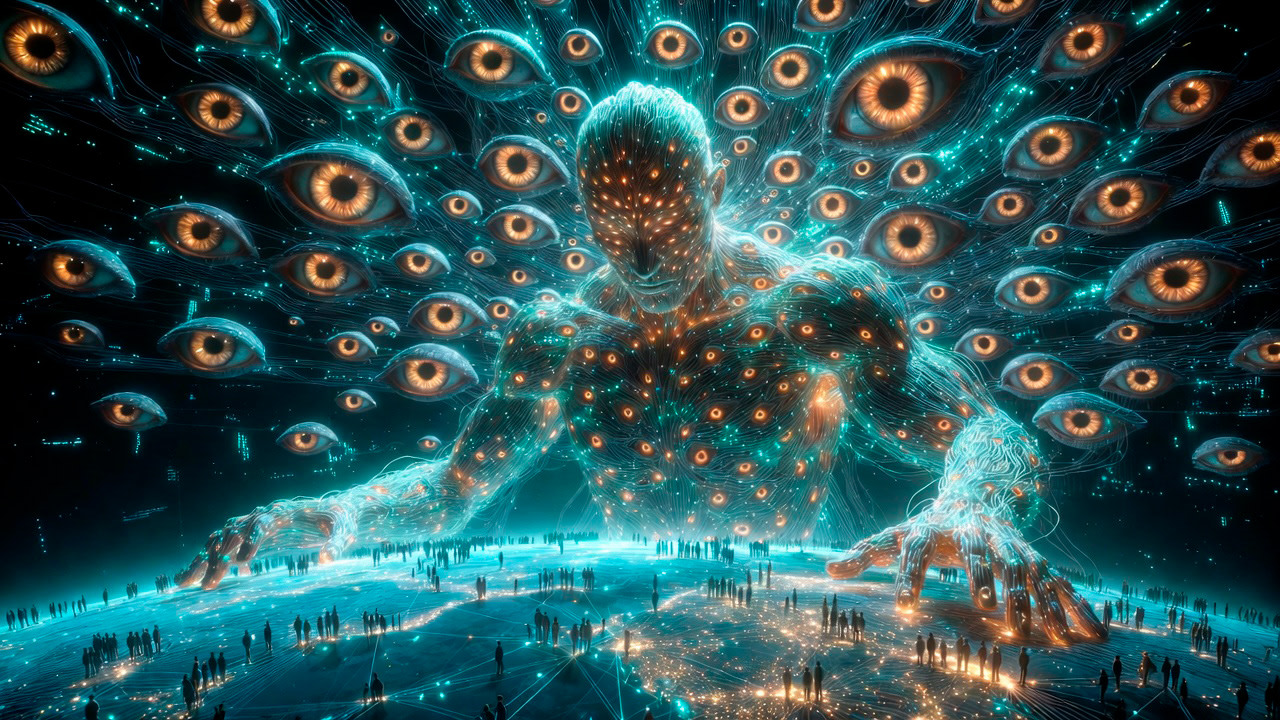
Subconscious behaviour—micro-pauses, cursor pressure, semantic rhythms, eye-tracking patterns—becomes “nuances.” These nuances function as a unique identifying token that allows each individual to be re-identified with more than 99% accuracy. Historical identity (name, national ID, biography) is replaced by a processable algorithmic identity. Every neural trace is transformed into an asset, enabling its conversion into a financial model.
III. The attention economy: time as the ultimate value
Human attention has become the scarcest and most valuable resource. Under the “singularity of attention,” power and narrative merge to maximise engagement and distort the perception of reality.
Against the model of “free services” in exchange for surveillance, the Data as Labour (DaL) paradigm emerges. If human interactions are what train and refine models with trillions of parameters, the time spent on the network ceases to be passive leisure and becomes productive labour that deserves direct remuneration.
| Data Concept | User Vision | Destination of Value | Social Impact |
|---|---|---|---|
| Data as Capital | Passive consumer | AI Platforms | Hyper-concentration of power |
| Data as Labour | Value creator / Worker | User (Royalties) | Economic agency and dignity |
| Data as Surveillance | Monitored subject | Third parties (Advertising, Military) | Democratic erosion and anxiety |
IV. Universal Basic Income (UBI) as palliation
Given estimates that place 60% of jobs in advanced economies at risk, Universal Basic Income (UBI) is presented as a pragmatic solution. However, from the standpoint of digital sovereignty, this centrally funded income (modelled on the Norwegian NBIM fund managing €1.85 trillion or other sovereign wealth funds) carries a serious risk: converting the population into pure consumers without economic agency.
The director of the Norwegian sovereign fund himself, Nicolai Tangen, acknowledges that “we have artificial intelligence and humanoid robots in development; intelligence is becoming ever cheaper. This will keep the cost of labour low. And those deflationary forces are good for the stock market.” With its headquarters literally facing the Palace where the Nobel Peace Prizes are awarded, it is paradoxical and unjust that this logic is not reversed: since intelligence is cheaper, Universal Basic Income is not only possible but a moral imperative. It is unjust that a fund benefiting from cheap labour perpetuated by AI continues to deny real opportunities to workers, transforming the technological dividend into a pacification subsidy that improves the lives of a few instead of a genuine recognition of ownership over the data and productivity generated.
The true alternative is not a state pacification subsidy but a social dividend that recognises individual ownership over the “synthetic twin”—the algorithmic duplicate of our digital life—and the data generated throughout one’s entire existence.
V. Agentic AI and the infrastructure of efficiency
The viability of argocapitalism rests upon a radically more efficient infrastructure that enables the continuous processing of “360-degree agentic memory” (emails, finances, calendars, emotional history, health, personal interactions…) at ever-decreasing costs.
- Humanoid robotics: Companies such as 1X Technologies (backed by OpenAI and Norwegian consortia) deploy NEO robots in domestic environments. These systems, trained with “world models,” learn by mere observation and capture data from private life to feed back into central neural networks.
 © 1x.tech
VI. Frameworks for protection and digital sovereignty
Faced with the exploitation of interiority, four fronts of resistance emerge:
-
Ethical governance (PRODXIA): AI Ethics and Technology Governance programmes become mandatory to audit “data exploitation” and ensure that vital management tools do not violate mental integrity.
-
Neurorights and neuroplasticity: Inspired by the legacy of Santiago Ramón y Cajal, Chile (a constitutional pioneer since 2021) and Spain’s Charter of Digital Rights shield mental privacy and strictly regulate emotional recognition in the workplace, prohibiting its use without explicit and revocable consent.
-
Resonance and pause: Following Byung-Chul Han, the recovery of the vita contemplativa—the right to inactivity—stands as the only authentic act of sovereignty against an economy that seeks to monetise every second of attention.
-
The technical gap: the right to be forgotten and the right not to be tokenised Despite legislative advances, these rights collide with a structural technical impossibility. The “right to be forgotten” (recognised in the GDPR, the Chilean neurorights law, and Spain’s Charter of Digital Rights) demands erasing an individual’s trace from systems. However, in language models with trillions of parameters, personal information does not reside in an isolated database but dissolves irreversibly into neural weights.
Machine unlearning—the technique that seeks to “unlearn” specific data—remains experimental, unscalable, and leaves residual traces. The only guaranteed solution is to retrain the entire model from scratch: an economically ruinous, energetically catastrophic, and practically impossible process at global scale.
Even worse is the right not to be tokenised. Once “nuances” (micro-pauses, cursor pressure, semantic rhythms, eye-tracking patterns) have been captured and converted into a unique identifying token, re-identification achieves accuracies exceeding 99%. At this point, anonymisation becomes fictitious: any attempt to “de-tokenise” the subject is as futile as trying to erase a fingerprint that is already part of the algorithm itself.
This technical gap reveals the true nature of argocapitalism: it does not merely extract value—it makes the extraction structurally irreversible.
| Key Concept | Definition in 2020 | Labour Implication |
|---|---|---|
| Argocapitalism | System of total surveillance and prediction | Data replaces fiat money |
| Subject-token | Behavioural nuance as unique identifier | Definitive loss of anonymity |
| Data as Labour | Remuneration for data generation | Time becomes the supreme value to be paid |
| Universal income | Subsidy for automation | Risk of centralisation of state power |
Conclusion
The transition to argocapitalism demands that technology and economics be radically subordinated to human dignity. While the system perfects the alchemy that converts thought and time into capital, frameworks for digital sovereignty—neurorights, ownership of the synthetic twin, the right to pause, and the fight against technical irreversibility—seek to ensure that the individual retains ownership over their most intimate nuances, their memory, and above all, their inalienable right to inactivity.
Human time remains the last frontier of value that cannot be completely expropriated. Welcome to digital humanism.
Infinite thanks to Ana María Ochoa Patiño for leading the debate “AI Ethics and Technology Governance”; it was an honour to participate alongside Waydell D. Carvalho and Jesús Carroll. A wonderful and timely meeting.


