We thought we knew almost everything about the Sage. We knew about the Nobel Prize, the drawings, the patient microscope in the study on Calle Alfonso XII, the sleepless nights pursuing the exact contour of a pyramidal cell. We even knew about the defiant young man who slipped out of the barbershop to draw saints, and the soldier who returned from Cuba with malaria and a chest full of broken hopes. One piece, however, was missing. And it mattered. That grey zone —human, procedural, almost bureaucratic— that separates the young physician from the consecrated professor: the academic chair competitions.

That grey zone now has a book of its own. It is titled Santiago Ramón y Cajal. El desafío de las cátedras (“The Challenge of the Chairs”), written by Professor José Manuel Porcel Pérez and published by Edicions de la Universitat de Lleida. It arrives in bookshops during World Book Day week with one hundred and eighteen elegant pages —hardcover, colour, carefully designed— and a remarkable biographical twist: its author was appointed Professor of Medicine at the Universitat de Lleida on 6 March 2026, as recorded in the BOE-A-2026-6412 official gazette. A newly minted professor —writing from the very top of the Spanish academic ladder— tells the story of how another professor, the most celebrated of all, reached that same position in his day. The mirror is so perfect it seems designed by chance.
A Nobel laureate who also failed
The word is harsh, but the book does not mince it: Cajal failed his first two chair competitions. Zaragoza, 1877. Granada, 1878. The Cajal in his early twenties turned up with enthusiasm and scant preparation at contests that were anything but lecturing exercises. And he lost. A second attempt at Granada in 1879-1880 ended the same way, this time less because of his own shortcomings and more because the decision —as Porcel documents from the archives— was “predictable” before the tribunal had even been sworn in.
The book contains a revealing personal detail. Porcel recovers a testimony by Cajal himself:
He admitted that he was not prepared, and that he had competed at the insistence of his father, who saw the university as a path to stability, rather than out of a fully mature academic vocation.
Behind the first stumble there is no scientist risking his intellectual life. There is an obedient son —Justo Ramón Casasús, a rural doctor who had himself fought his way up from Pyrenean villages to the Chair of Anatomical Dissection in Zaragoza— following the family script. The Cajal who fails in Zaragoza is still a candidate by commission. The one who will win Madrid fourteen years later is something else entirely: a scientist who has learned, through defeat, that the university is not a formality but a terrain.
There is something consoling in this. If the man who would become the first Spaniard to win the Nobel Prize in Medicine in 1906 failed three times before winning his first chair, then academic failure is no sign of mediocrity. It is, in many cases, a rite of passage. As Porcel puts it: “even great scientists begin as insecure candidates who need to fail in order to advance”.
Four cities, four competitions
The structure of the book follows, chapter by chapter, the geographical and emotional itinerary of the young Cajal across the map of the Spanish university during the Restoration:
- Zaragoza, 1877 — The insecure debut. First competition. First fall.
- Granada, 1878 — Second attempt. Second setback.
- Granada, 1879-1880 — A predictable defeat, in Porcel’s words. The system already has its favourites before the tribunal even convenes.
- Valencia, 1882-1883 — At last, winning a chair. Fourth time lucky. Cajal becomes Professor of Descriptive Anatomy.
- Madrid, 1890-1892 — The decisive chair. Histology and Normal and Pathological Histochemistry. The springboard from which, starting in 1906, he would illuminate the entire map of the nervous system.
But there is a geography missing from that index, and Porcel does not overlook it: Barcelona. Between Valencia and Madrid, Cajal moves to the Catalan capital (1887), and it is there that he carries out the essential work that would earn him the Nobel. The chairs he won gave him salary, status and institutional stability. But the discovery —the neuron doctrine, dynamic polarisation, the “butterflies of the soul”— was largely conceived in Catalan laboratories. The moral is unsettling: the chair system did not reward Cajal when Cajal was doing his best science. It only rewarded him afterwards.
The Restoration university as protagonist
Porcel’s book, despite appearances, is not a biography. It is an institutional microhistory. The author dives into original minutes, regulations, calls for competition and contemporary testimonies to reconstruct with watchmaker precision how the Spanish university system operated between 1875 and 1895. Tribunals appointed by the Ministry of Public Works. Oral examinations beneath plaster vaults. Memoranda read aloud for an hour and a half without pause. Trincas —that format in which candidates confronted one another like intellectual roosters— that could decide an academic life in twenty minutes of cross-examination.
The ninth chapter, Cajal and the University, and the tenth, Masters, Rivals and Mediators, sketch that sociological map. Cajal was not a genius floating above institutions. He was a candidate among candidates, a professor among professors, someone who had to learn the rules of the academic game as meticulously as he learned to fix a histological section with silver chromate. Scientific excellence, Porcel reminds us, needs a place to land. And in nineteenth-century Spain, that place was called a chair.
The foreword: Antonio Campos Muñoz and Cajal’s seat
The book opens with a foreword by Antonio Campos Muñoz, and this detail deserves to be told slowly because it is no ordinary foreword. Campos has been Emeritus Professor of Histology at the University of Granada since 1981 —yes, Granada: the very city where Cajal failed twice— and since 2004 he has occupied, at the Royal National Academy of Medicine, the same academic seat that once belonged to Santiago Ramón y Cajal. There is no more beautiful coincidence. The man who writes the opening pages of this book inhabits, in the most literal institutional sense, the chair left vacant by the book’s protagonist upon his death in 1934.
Antonio Campos is also something more. He is one of the great names of contemporary Spanish histology: a pioneer in the study of mineralised tissues, the driving force behind tissue engineering in Spain, founder of the group that built, in his laboratory, the first complete artificial cornea. He has been President of the Spanish Society of Histology, Dean of the Faculty of Medicine of Granada, President of the European Association of Faculties of Medicine, Director of the Carlos III Institute of Health, and promoter of the Cajal Plan —forerunner of today’s SICUE programme— for the mobility of medical students in Spain. He is Doctor Honoris Causa by the National University of Córdoba (Argentina), Member of Number of the Royal National Academy of Medicine where he holds Seat No. 38 (Histology) —Cajal’s own seat— and, as could hardly be otherwise in this archive, Distinguished Cajalist.
His prologue voice adds to Porcel’s book what no one else could: the authority of someone who has devoted his life to the same discipline as Cajal —histology—, in the same city where the chair journey began, and from the academic seat left vacant by the Nobel laureate. It is, quite literally, Cajal’s institutional continuity speaking about how Cajal became a professor.
Chair, science, and time
Science advances not only by the force of ideas, but also by its capacity to find a place within concrete institutions, with their rhythms, resistances, and balances. To understand Cajal’s competitions is to understand the historical conditions that made possible —and difficult— the birth of modern science in the Spanish university.
That paragraph, from the book’s back cover, works as a thesis. And it is a thesis that speaks to the present. Because chair competitions still exist. Chairs are still called. Tribunals still deliberate. And today’s scientists continue to weave their intellectual lives through the same fabric of merit, waiting and convocation that Cajal wove. The book is, at once, a historical essay and a document about the present.
The author: José Manuel Porcel Pérez
Born and trained between Lleida and Barcelona, Dr. José Manuel Porcel is an internationally recognised figure in pleural medicine. First Vice-President of the Spanish Society of Internal Medicine (SEMI), Head of the Internal Medicine Department at the Arnau de Vilanova University Hospital in Lleida, Principal Investigator at IRBLleida, and, since March 2026, Professor of Medicine at the Universitat de Lleida. He has published nearly four hundred scientific articles, edits the European Respiratory Journal and ERJ Open Research, created at Arnau de Vilanova Spain’s first Pleura Unit, and has accumulated distinctions that few Spanish physicians can show: Obieta Prize of the Royal National Academy of Medicine (2020), Master of the American College of Physicians (2023), Fellow of the Royal College of Physicians of London (2025), and the “Dr. José Eleuterio González” Medal of the Autonomous University of Nuevo León —the highest health-sector honour granted by that Mexican institution (2025).
That a physician with this record should devote months of research to reconstructing how Cajal became a professor is, in itself, a gesture of deep kinship with the tradition he sees himself as heir to. The book carries between its lines a profound thank-you to the man who opened the way.
Book details
| Title | Santiago Ramón y Cajal. El desafío de las cátedras |
| Author | José Manuel Porcel Pérez |
| Foreword | Antonio Campos Muñoz |
| Publisher | Edicions i Publicacions de la Universitat de Lleida |
| Year | 2026 |
| Pages | 118 |
| Format | 15.5 × 21.5 cm, hardcover, colour illustrations |
| Language | Spanish |
| ISBN | 978-84-9144-606-4 |
| Price | €22.50 (RRP €25.00) |
| Publisher link | publicacions.udl.cat |
”Why Cajal?” — The voice of Antonio Campos
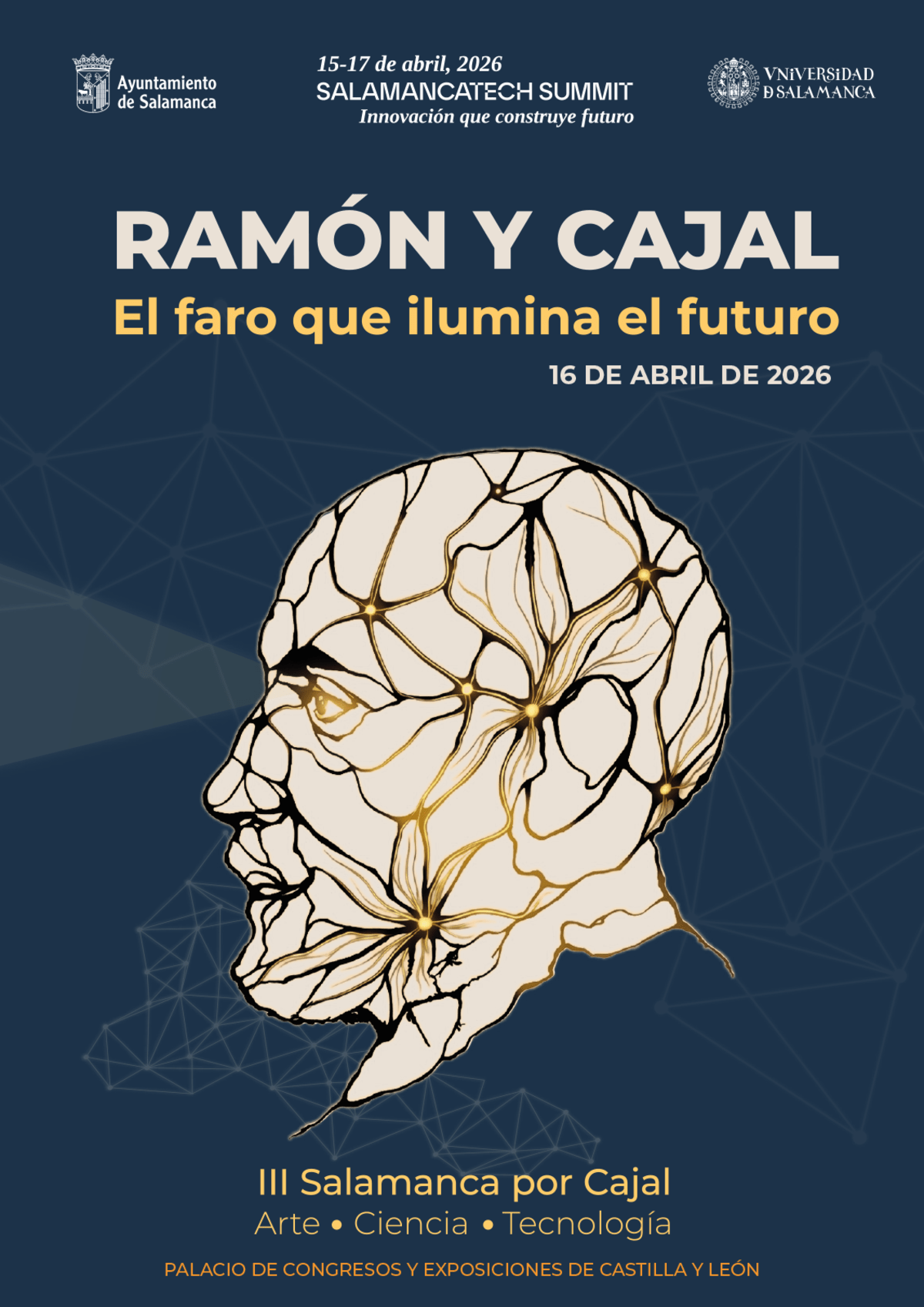
We close this piece with a flourish: Antonio Campos Muñoz’s intervention at the III Salamanca for Cajal: Art, Science and Technology 2026 symposium, in which he answers the question that gives meaning to all the above. Why Cajal. Why now. Why we keep returning to him whenever we need to remember what excellence is, what method is, what will is.
To understand Cajal’s chair competitions, as Porcel proposes, and to listen to Campos ask Why Cajal?, are two sides of the same intellectual gesture: recognising that science takes place within specific institutions, with their roughness and their slowness, and that speaking about Cajal in 2026 is not nostalgia but a way of thinking better about the university we have and the one we want.