Article dedicated to Cristina Nombela Otero, Elena Giné Domínguez, and Fernando de Castro Soubriet, who rescued the women of the Cajal School from oblivion.
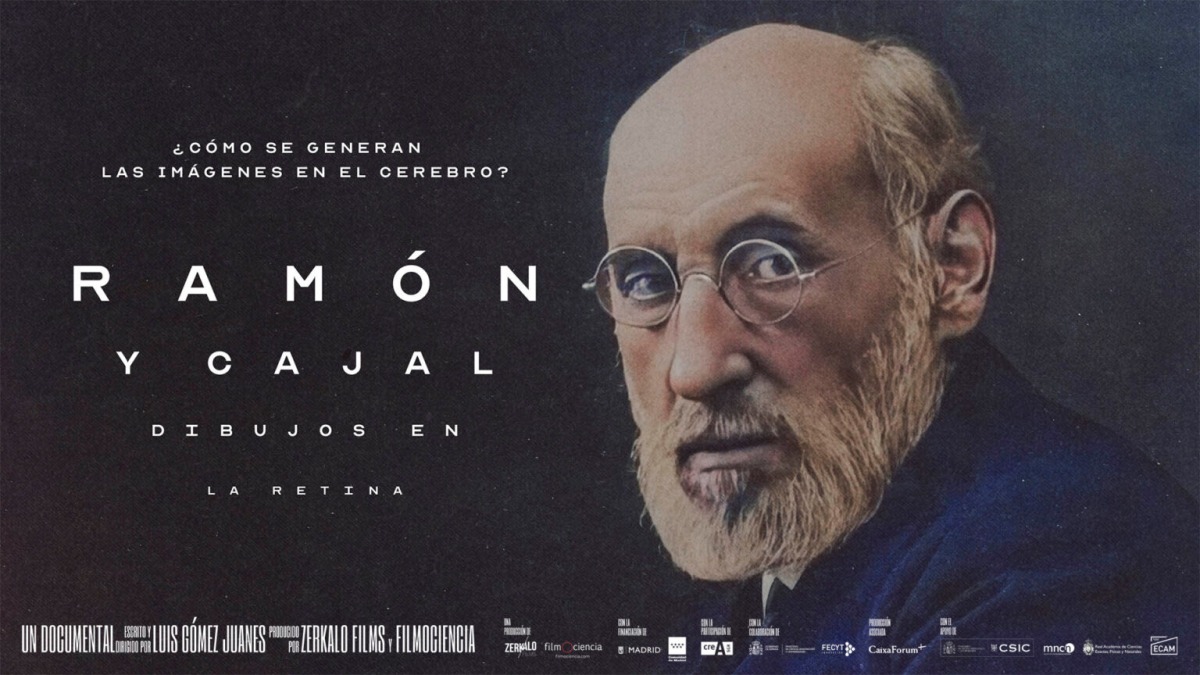
How do photons become consciousness? How does the brain construct the illusion we call reality? These were the questions that obsessed Santiago Ramón y Cajal throughout his life, and they are the same ones beating at the heart of Ramón y Cajal: dibujos en la retina (Ramón y Cajal: Drawings on the Retina), the feature-length documentary directed by Luis Gómez Juanes that opens in cinemas across Spain from 9 April 2026.
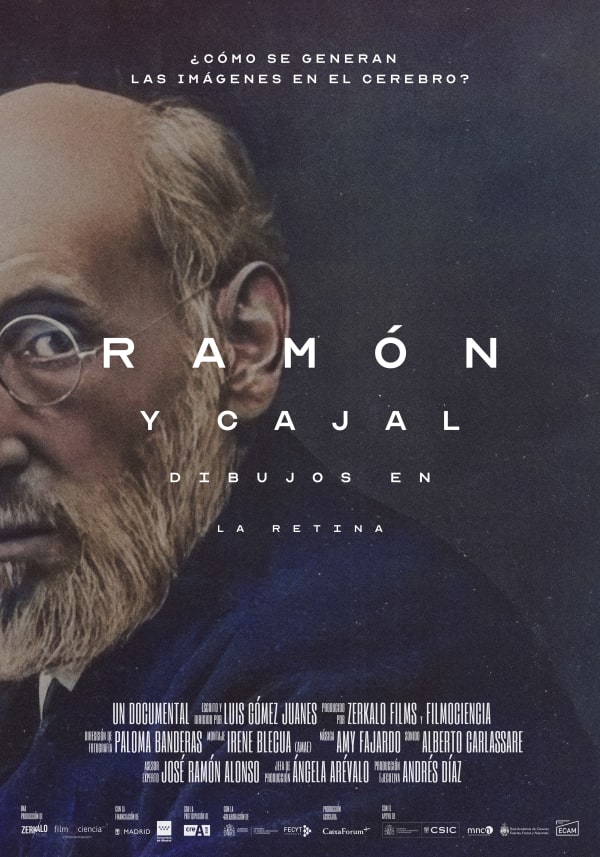
The film, produced by Zerkalo Films and Filmociencia with the support of FECYT, runs for 101 minutes and explores Cajal as a visionary who transcends his own science—a frustrated artist who ended up drawing the first great map of human consciousness. In one of his laboratories, a state-of-the-art machine attempts to answer his last great question: how are images formed in the brain? Screenings include post-film discussions with director Luis Gómez Juanes.
Cajal, the artist who could not be
Before becoming the undisputed father of neuroscience, the young Santiago wanted to be a painter. His father quashed those aspirations, but Cajal carried with him the pencil and the gaze of the artist. When he applied Golgi’s technique to nervous tissue, he did not merely observe: he translated chaos. With India ink and watercolour, he traced pyramidal cells, stellate astrocytes, and the delicate amacrine cells of the retina. In drawing them, he was interpreting them—performing a supreme exercise in scientific visualisation that today, paradoxically, remains irreplaceable.
The textbooks of the world’s most prestigious universities still rely on his drawings traced in 1892. The documentary invites us to ask why: because Cajal’s drawing was not a photocopy of reality dead beneath the glass, but the functional diagram of a living organ.
“Like the entomologist hunting brightly coloured butterflies, my attention pursued, in the garden of grey matter, cells of delicate and elegant forms, the mysterious butterflies of the soul.” (“Como el entomólogo a la caza de mariposas de vistosos colores, mi atención perseguía, en el jardín de la sustancia gris, células de formas delicadas y elegantes, las misteriosas mariposas del alma.”) — Santiago Ramón y Cajal, Recuerdos de mi vida (Recollections of My Life)
The discussion: De Castro and Nombela
After the screening, director Luis Gómez Juanes will participate in a discussion alongside Fernando de Castro Soubriet, principal investigator of the Developmental Neurobiology Group at the Instituto Cajal (CSIC), moderated by Cristina Nombela Otero, associate professor at the UAM.
Cristina Nombela’s presence adds a special dimension to the event. Beyond her clinical research on Parkinson’s disease, she has led the most exhaustive historiographic effort on the female presence in the Cajal School, rescuing names such as Laura Forster, Manuela Serra, and the illustrators Conchita del Valle and Mª G. Amador—women whose precise hands translated anatomical processes into a universal visual language, enabling Spanish neuroscience to dominate the publishing world of its era.
“Ideas do not last long. One must do something with them.” (“Las ideas no duran mucho. Hay que hacer algo con ellas.”) — Santiago Ramón y Cajal
Cinemas and dates
Madrid
- Cine Embajadores: 9 April, 7.30 pm — Discussion with director Luis Gómez Juanes, Jaime Brihuega and Mª José Rebollo (sold out)
- MK2 Cine Paz: 11 April, 12.15 pm — Discussion with the director, Ángela Nieto and Ana Crespo
- MK2 Palacio de Hielo: 13 April, 8.00 pm — Discussion with the director, Fernando de Castro and Cristina Nombela
- Pequeño Cine Estudio: 10, 11, 12 and 15 April
Zaragoza
- Cines Palafox: 7 April, 6.30 pm (preview screening) — Discussion with the director, José Mª Serrano, Alberto J. Schuhmacher and Eva Pérez Sorribes
- Cines Aragonia: 11 and 12 April, 12.15 pm
- Cines Palafox: 14 and 21 April, 6.30 pm
- CaixaForum: 29 April — Discussion with the director
Valencia
- ABC Park: 11 April, 8.00 pm — Discussion with the director and Isabel Fariñas
Oviedo
- Cine Embajadores Foncalada: 13 April, 8.00 pm — Discussion with the producer, Juan José Martínez Jambrina and Ana Coto
Santander
- Cine Embajadores Santander: 14 April, 8.00 pm — Discussion with the producer and Mª Fuencisla Pilar Cuéllar
Barcelona
- Cinemes Can Castellet: 16 April, 5.00 pm and 9.00 pm
Seville
- MK2 Nervión Plaza: 20 April, 8.00 pm — Discussion with the director, Susana P. Gaytán Guía and Mª del Rosario Martínez
Cádiz
- MK2 Bahía de Cádiz: 21 April, 8.00 pm — Discussion with the director and Alberto Pascual Bravo
Córdoba
- MK2 El Tablero: 23 April, 8.00 pm — Discussion with the director
Badajoz
- MK2 Conquistadores: 27 April, 8.00 pm — Discussion
Trailer
Voices in the documentary
The documentary brings together the voices of some of the most prominent scientists and experts connected to Cajal’s legacy: Rafael Yuste, Ángela Nieto, José Ramón Alonso, Laura López Mascaraque, Juan de Carlos, Paula Anta, Jaime Brihuega, Fernando de Castro, Yolanda Polo, José María Serrano and Juan Pimentel.
Crew
- Director and screenwriter: Luis Gómez Juanes (Filmociencia)
- Executive producer: Zerkalo Films
- Head of production: Ángela Arévalo
- Director of photography: Paloma Banderas Bielicka
- Head of sound: Alberto Carlassare
- Editor: Irene Blecua
- Original score: Amy Fajardo
- Expert adviser: José Ramón Alonso Peña
Festival history
The film arrives in cinemas following its world premiere in November 2025 at the Festival Rizoma de cultura entrelazada, which sold out. In March 2026, the documentary was part of the Brain Film Fest programme (11–15 March, Barcelona), with a special screening and discussion in Madrid (Fundación Telefónica), both at full capacity.
Collaborating institutions
The documentary is funded by the City of Madrid and the Community of Madrid, with the participation of CreA SGR, the support of FECYT (Ministry of Science, Innovation and Universities) and associate production by CaixaForum+. It has received support from ECAM and numerous institutions: CSIC, National Museum of Natural Sciences, Cajal Centre for Neuroscience–Instituto Cajal, Royal Academy of Exact, Physical and Natural Sciences, Archivo Científico Fernando de Castro, University of Zaragoza, Royal Academy of Medicine of Zaragoza, Official College of Physicians of Madrid, Institute of Neurosciences of Alicante, Institute of Neurosciences of Castilla y León, Residencia de Estudiantes, National Library of Spain, Severo Ochoa Centre for Molecular Biology (CSIC-UAM), Spanish Society of Neurology, Museo Lázaro Galdiano, Royal National Academy of Medicine of Spain, Centre de Recherche Cerveau et Cognition CerCo (CNRS, UPS), Factoría Heliográfica, Ayerbe Town Council and Petilla de Aragón Town Council, among others.
About the director
Luis Gómez Juanes is a director and screenwriter who trained at ECAM and holds a degree in Physics from the UAM. In fiction, he wrote the screenplay for Europa (2017), selected at Seminci and the Moscow International Film Festival. In documentary, he worked on Behind Lucy (broadcast on RTVE as El viaje de Lucy). He runs his own production company, Filmociencia, specialising in science communication.
Practical information
National release: 9 April 2026 Running time: 101 minutes Production: Zerkalo Films and Filmociencia Director: Luis Gómez Juanes
Source
Zerkalo Films · Filmociencia (2025). Ramón y Cajal: dibujos en la retina. zerkalofilms.com