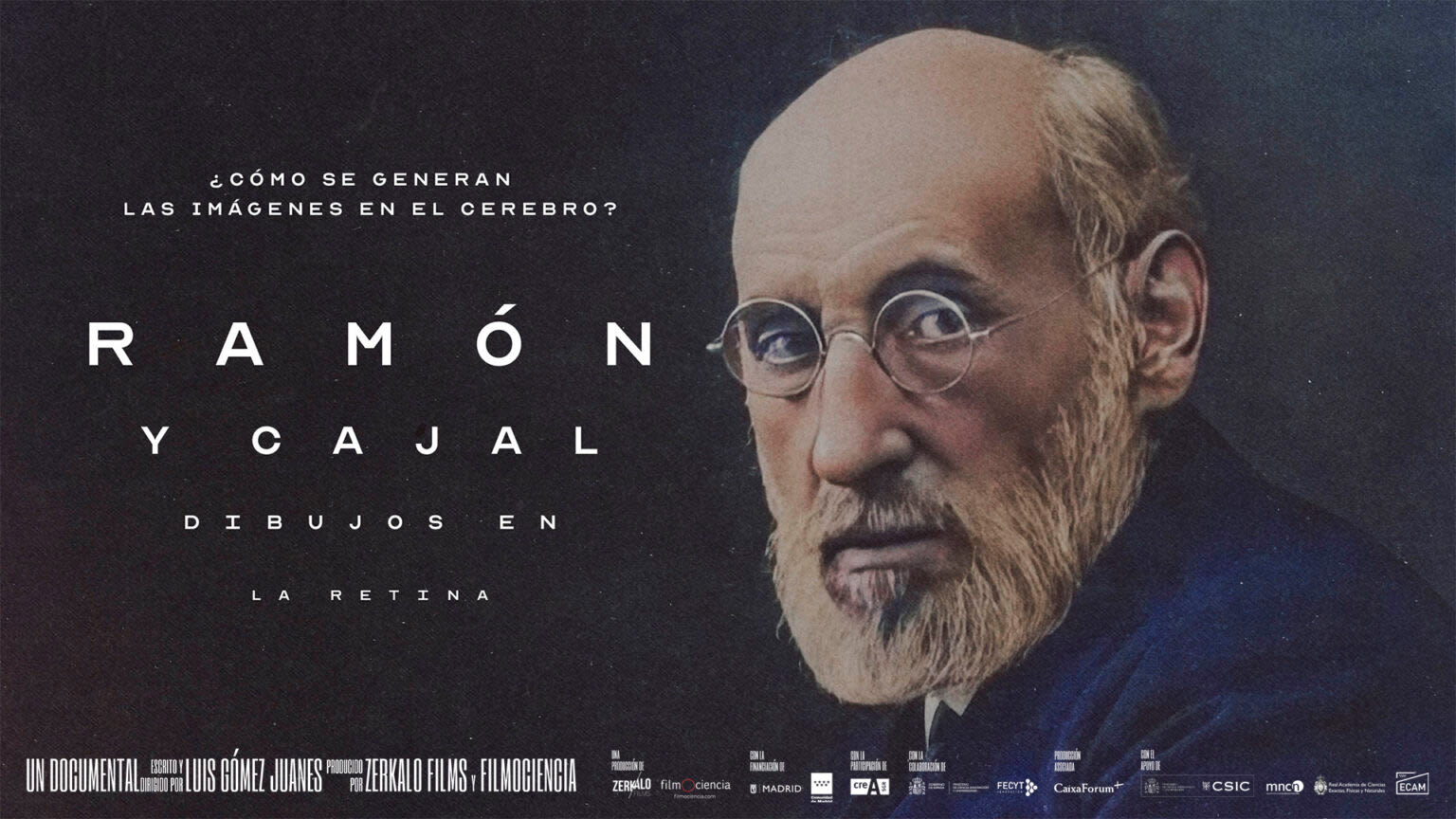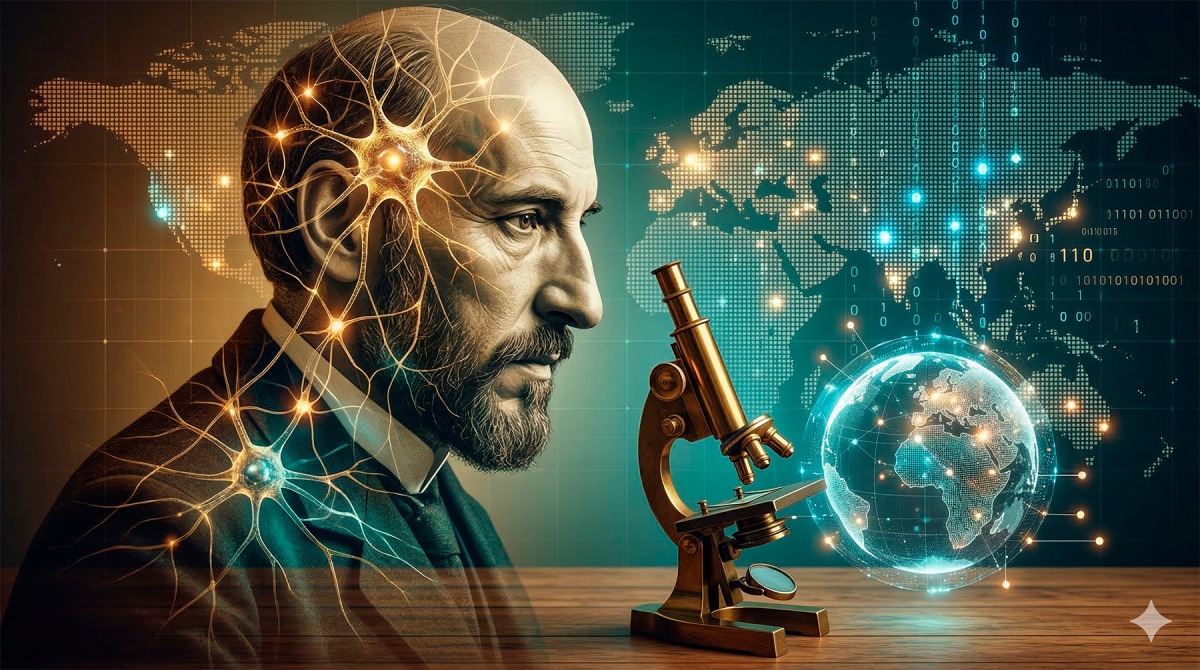
In the dimness of a makeshift laboratory, surrounded by the silence of a fin-de-siècle Spain, Santiago Ramón y Cajal observed what others considered an inextricable chaos. There, amid silver and chromium stains, the Master not only discovered the individuality of the neuron but traced the first map of the architecture of thought. Today, that spirit of rigorous observation and indomitable will—the Ad augusta per angusta that marked his life—is projected toward a new frontier: artificial intelligence. In the same way that Cajal synthesised “pixels of knowledge” in his masterful plates, contemporary systems such as GroundSource by Google Research today rescue scattered fragments of information to protect life on a planetary scale.
I. The aesthetics of truth: the legacy of the Spanish Neurohistological School
Santiago Ramón y Cajal (1852–1934) was, above all, a visionary of structure. His Neuron Doctrine was not a chance finding but the fruit of a cognitive sovereignty earned painstakingly before the microscope. By demonstrating that the nervous system was not a continuous network but a dialogue between discrete and autonomous units, Cajal not only founded modern neuroscience; he laid the logical foundations of what we now call neural networks.
Aesthetic mastery and microphotography
For the sage, drawing was not a mere aid; it was a conceptual synthesis. His illustrations, now designated UNESCO World Heritage, do not copy reality but interpret it to reveal its intrinsic order. This visual rigour extended to his passion for photography, where he experimented with methods such as Lippmann’s, of which the Cajal Legacy preserves pieces of extraordinary worldwide rarity. This capacity to integrate the cutting-edge technology of his time into the pursuit of scientific truth is the beacon guiding the current digitalisation of his archive.
| Cajalian Element | Scientific Significance | Transcendence in AI |
|---|---|---|
| Neuron Doctrine | Cells as autonomous units | Discrete nodes and parameters |
| Dynamic polarisation | Unidirectional signal flow | Feed-forward architectures |
| Dendritic spines | Contact points and plasticity | Weight adjustment and synaptic learning |
| ”Butterflies of the soul” | Pyramidal cells of the cortex | Deep processing layers |
| Will and perseverance | Method as the engine of genius | Iteration and algorithmic optimisation |
II. Recognising the vanguard: the Cajal and AI Prize
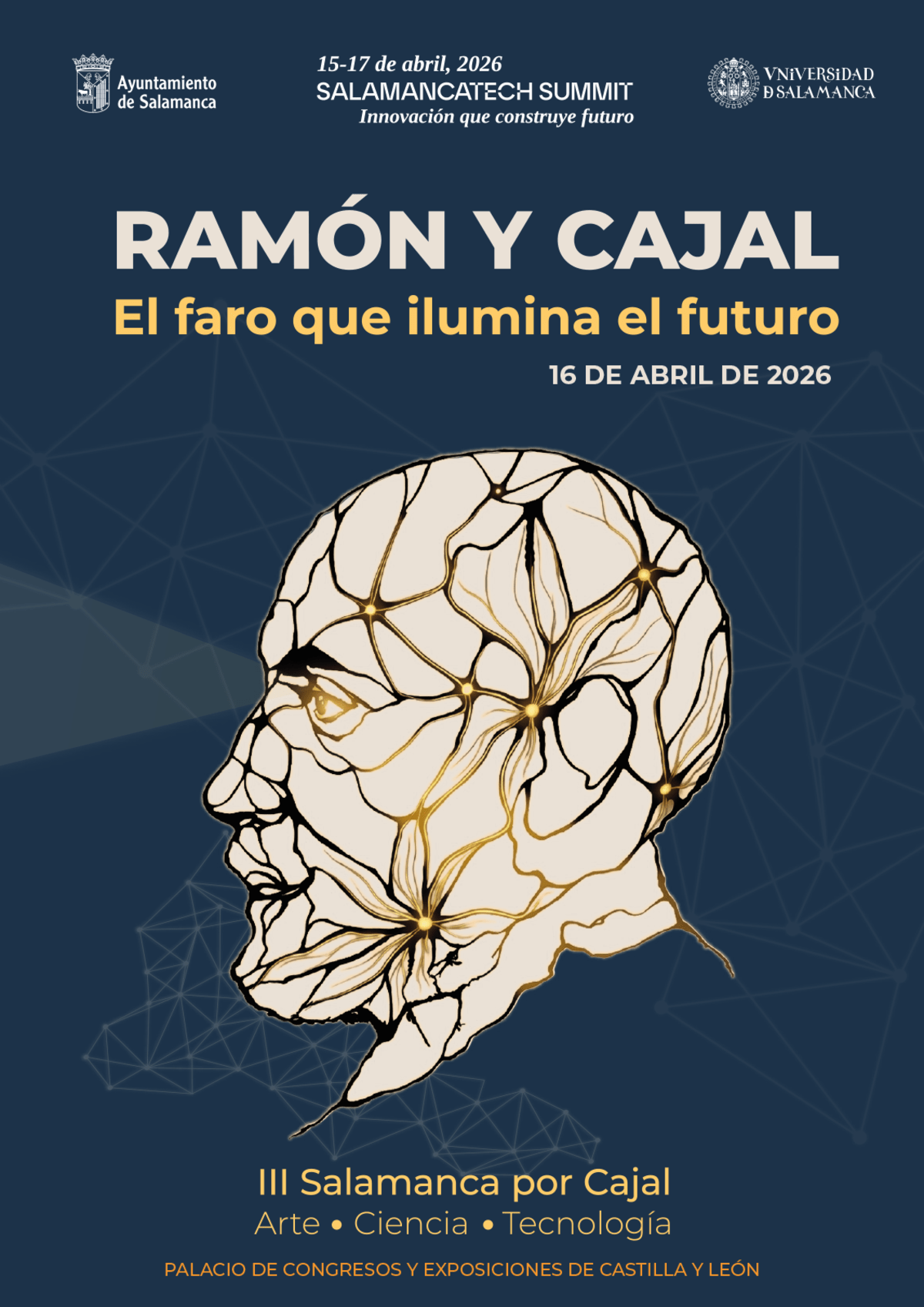
Cajal’s relevance is not merely historical; it is active. At the “Salamanca: for Cajal and Science” conference, the presentation of the D. Santiago Ramón y Cajal and Artificial Intelligence Prizes symbolises this bridge between centuries. This award, granted by the AIR Institute, recognises those who, like the Master, use the tools of their time to decipher biological complexity through algorithms and computational models.
III. GroundSource: meticulous surveillance in the age of data
In a transition that Cajal himself would have admired for its social utility, the artificial intelligence of GroundSource acts today as a “global microscope.” While the Master analysed the cholera bacillus to save populations in the Spanish Levant, Google Research today uses the Gemini model to address “data deserts” in the management of climate crises.
Thanks to this deployment, GroundSource has identified 2.6 million flood events, compared to the mere 10,000 recorded in manual databases. This ability to “connect the dots” with a 99% recovery rate for severe events enables science to shift from reactive observation to proactive prevention.
IV. The frontier of knowledge: prospective configuration vs. backpropagation
The comparison between the human brain and language models reveals an astonishing conceptual depth. Research from the University of Oxford has shed light on a fundamental difference: while AI relies on backpropagation to adjust its errors, the human brain employs a “prospective configuration.”
Before modifying its connections, neurons settle into a balanced state that protects prior knowledge, avoiding the “catastrophic forgetting” suffered by machines. This biological elegance enables a human being to learn after a single exposure, while an AI requires thousands of examples to achieve the same stability. It is the modern confirmation of the plasticity that Cajal intuited: a system that not only stores but preconfigures itself for excellence.
V. The digital cathedral: the Cajalian Dataverse
One of the great current institutional milestones is the development of a “Dataverse” on the Cajalian world. This is not simply an archive but a living ecosystem that seeks to centralise the more than 28,000 pieces of the Legacy. Using scalable platforms, the project aspires to enable the sage’s drawings, histological preparations, and manuscripts to dialogue with one another.
VI. AI and rare diseases: a commitment to alleviating suffering
Cajal’s legacy is profoundly humanist. The collaboration between the Instituto Cajal of the CSIC and the Isabel Gemio Foundation personifies this continuity through the use of AI to research rare diseases. Projects such as AI-KnownRD (Artificial Intelligence for Structuring Mechanistic Knowledge in Rare Diseases), led by Dr Mónica Chagoyen, use data science to structure knowledge in minority pathologies, seeking therapeutic targets where before there was only uncertainty.
VII. Toward 2026: prediction as the protection of global health
By March 2026, the vision of GroundSource has expanded toward “Planetary Health.” Google’s Earth AI platform no longer merely maps floods but predicts outbreaks of diseases such as dengue or malaria before the first contagion occurs. Under the direction of Yossi Matias, this technology detects the convergence of risks—stagnant water, extreme heat, and population movements—to issue early warnings. It is the ultimate fulfilment of Cajal’s mission: the use of scientific observation to prevent human suffering on a global scale.
VIII. Ethics and the “trap of instant history”
Despite the technological dazzle, the path demands caution. There is a risk of “instant history”: the illusion that an algorithm can replace decades of expert interpretation. Cajalian rigour reminds us that AI must be an assisted tool, a “companion in the loop” that enhances human intelligence without displacing the necessary critique of sources.
Conclusion: the will to know
As with the example of Santiago Ramón y Cajal, nothing inspires more veneration than a life devoted to work and study. By integrating his immense legacy into the currents of artificial intelligence, we are not simply digitising papers; we are honouring a way of understanding the world.
From the Master’s microscope to the predictive models of 2026, science remains that “infinite loom” where each thread of information allows us to glimpse a more resilient future. The sage taught us that the brain is an impenetrable forest, but also that with patience and method, light eventually filters through the branches. In this new century, artificial intelligence is the lantern that helps us traverse those paths, always under the eternal guidance of the one who first saw the architecture of our soul.