The University of Salamanca, established at the dawn of 1218, is not merely the dean of Hispanic letters; it is the alma mater where the consciousness of modernity germinated. In its classrooms, shortly after Oxford and Paris had traced their paths, Salamanca became the crucible where the Spanish language fused with scientific rigour to challenge power and justice. Today, as we commemorate the Fifth Centenary of the School of Salamanca, we stand before a milestone of universal dimension that projects the enduring relevance of an intellectual movement which, in 1526, changed the course of Western thought under the mastery of Francisco de Vitoria.
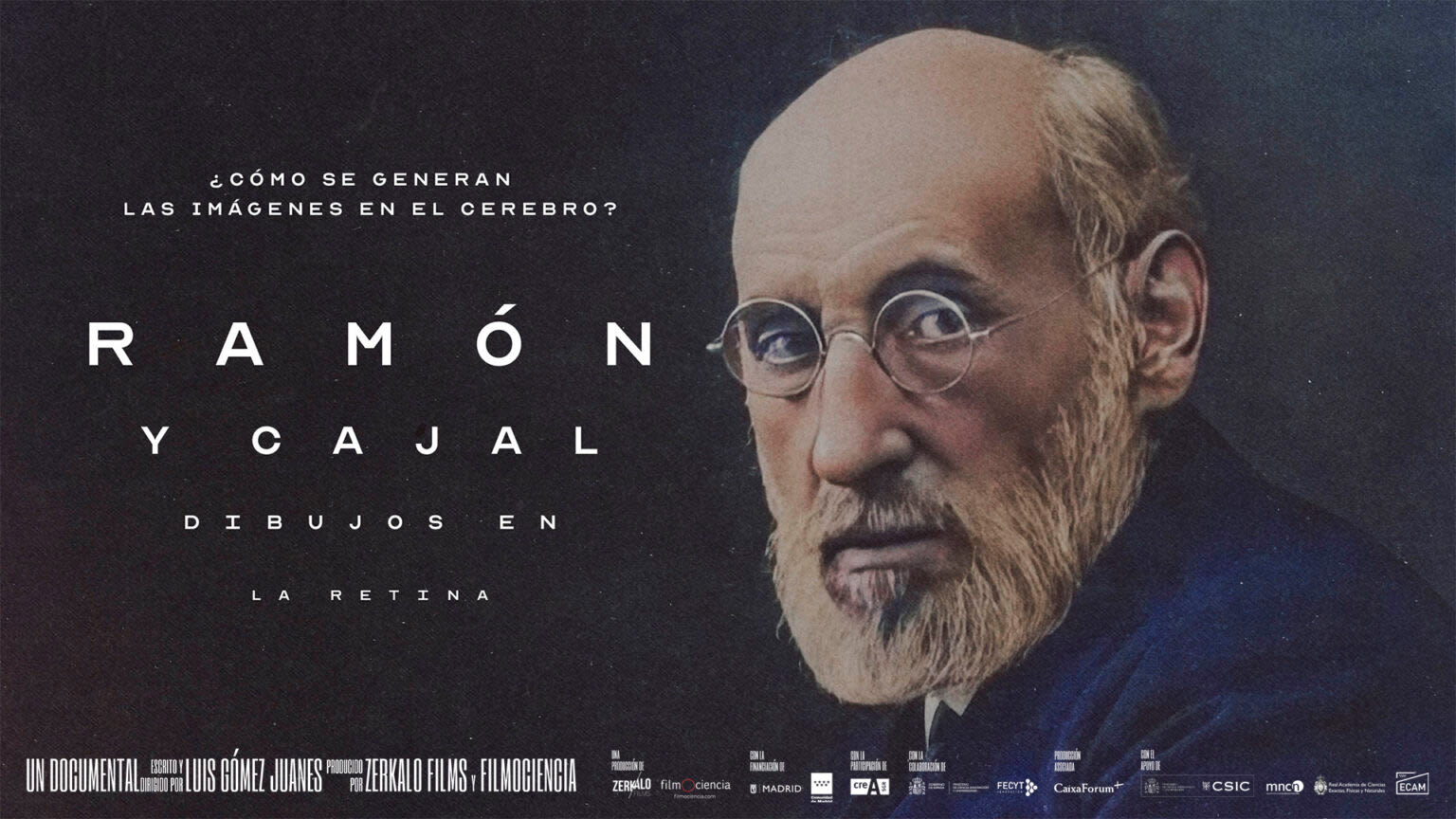
This legacy of independence and commitment to truth finds its natural heir in the illustrious figure of Santiago Ramón y Cajal. As the Rector of the University of Salamanca has observed, there exists a profound confluence between the intellectual restlessness of the Salamancan doctors and the exploratory zeal of the Aragonese Nobel laureate; both were sowers of a lineage that knows no twilight.
An appointment with history: the gathering of 17 March
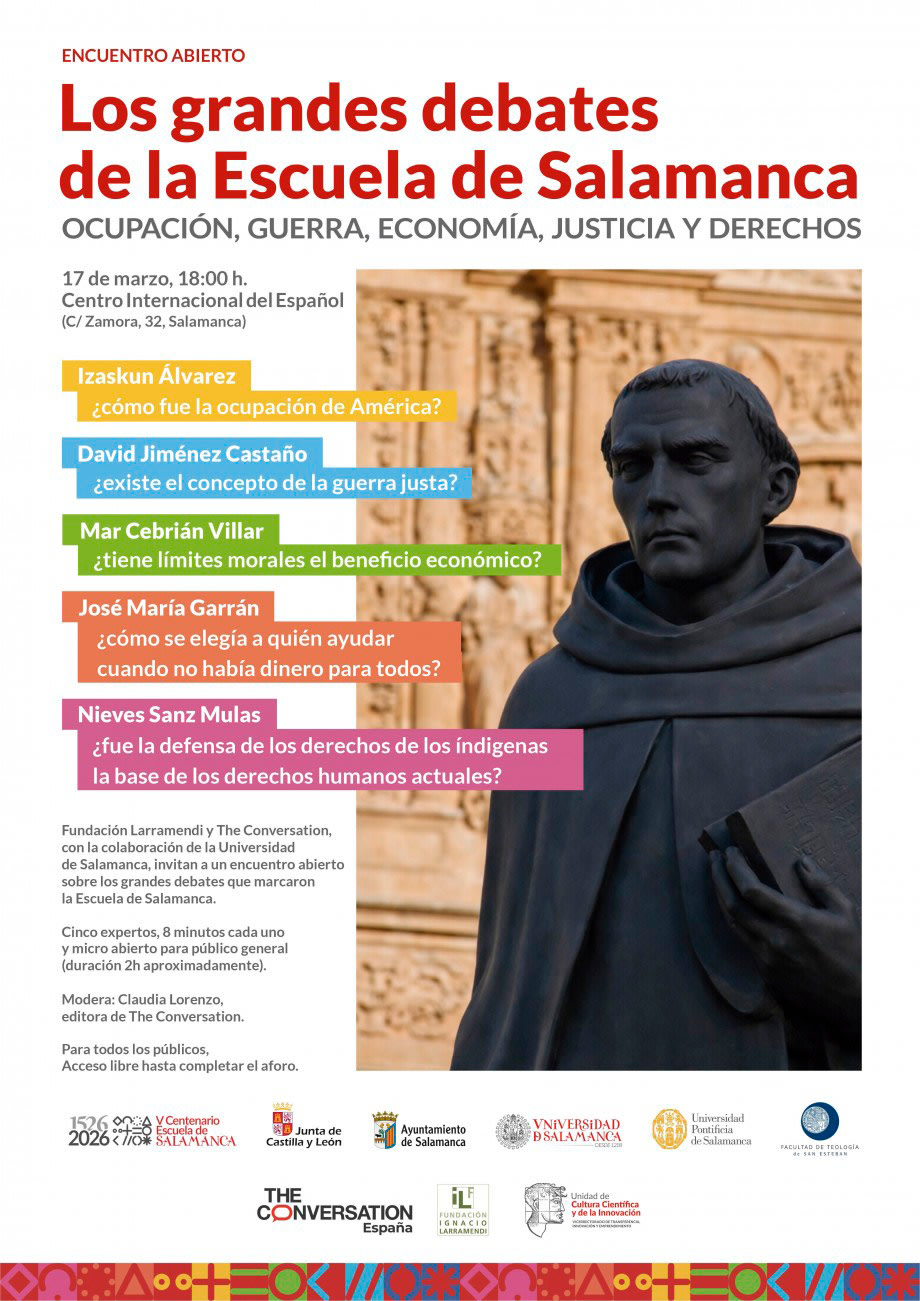
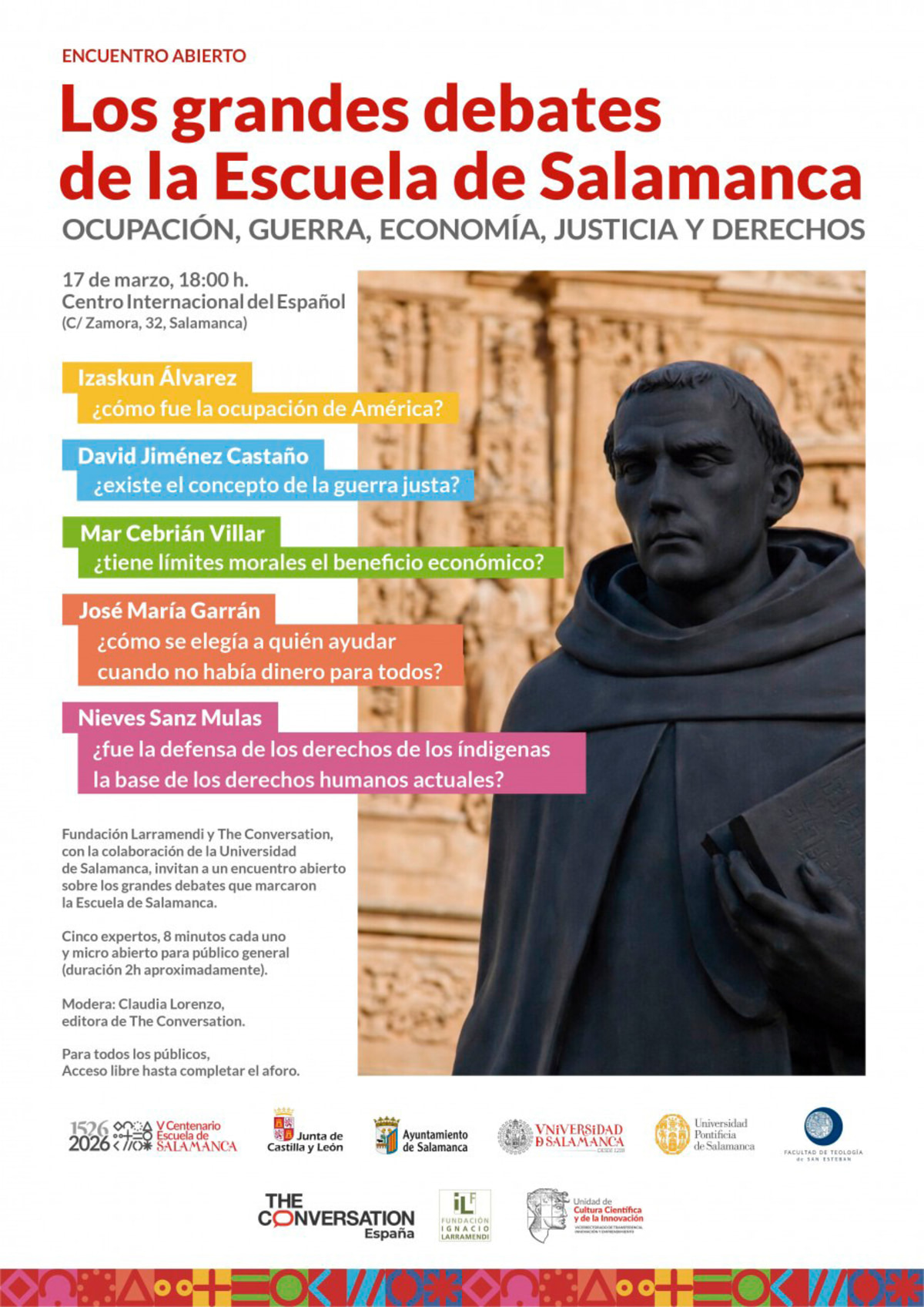
Under the sky of Salamanca, on 17 March at 6:00 pm, the Centro Internacional del Español (C/ Zamora, 32) will host the open event: “The great debates of the School of Salamanca: occupation, war, economy, justice, and rights.” Organised by the Fundación Larramendi and The Conversation, with the support of the Science Culture and Innovation Unit (UCC+i) of USAL, this conference is not a mere anniversary but an act of intellectual resistance.
Five specialists, in a dynamic eight-minute format, will revisit the moral dilemmas that defined the School and that today, in a world saturated with stimuli, demand a measured and profound gaze. The moderation by editor Claudia Lorenzo will serve as a guide on this journey through reason and ethics.
Human dignity as the cornerstone
Santiago Ramón y Cajal declared: “Have you no enemies? Is it that you never told the truth or never loved justice?” (“¿No tienes enemigos? ¿Es que jamás dijiste la verdad o jamás amaste la justicia?”). This same moral courage animated the School of Salamanca to claim, for the first time in history, the natural rights of man.
-
The occupation of America: Professor Izaskun Álvarez will address the thorny question: how was the occupation of America carried out? In the sixteenth century, Salamanca rose against the idea of the indigenous person as an incapable being, recognising their full humanity and their inalienable right to land and freedom.
-
The seed of human rights: Dr Nieves Sanz Mulas, Director of CIDH-Diversitas, will explore whether the defence of indigenous peoples was the basis of current rights. By placing the dignity of the person above political power, the Salamancan masters drafted the first foundations of a protection that Nieves Sanz today defends against vulnerability and exclusion.
The rigour of war and the duty of justice
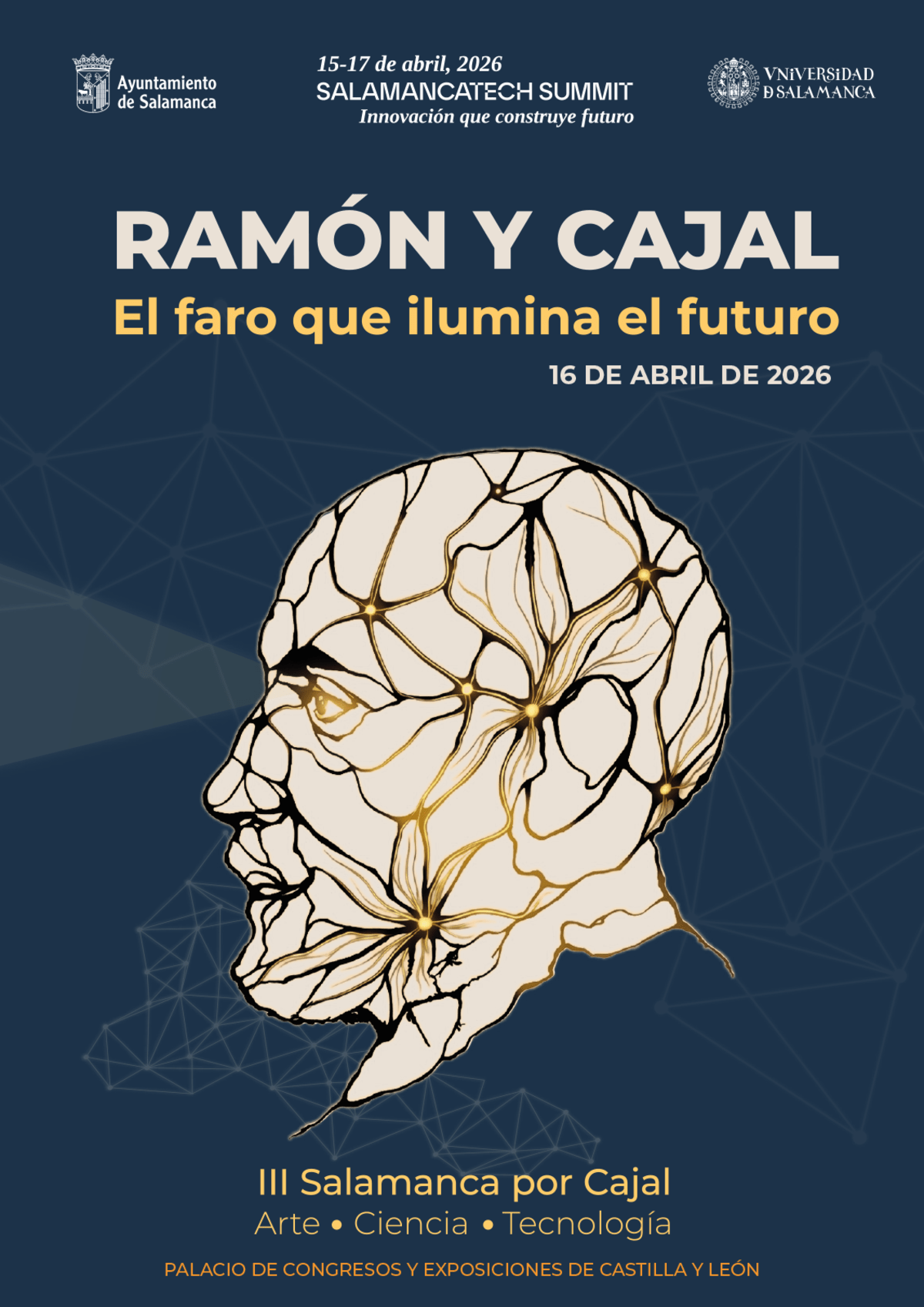
For Cajal, neurons were the butterflies of the soul whose secrets might illuminate mental life. For the School of Salamanca, the secret of coexistence resided in the law of nations (ius gentium).
-
Just war: David Jiménez Castaño will ask: does the concept of just war exist? His research on the discrepancies between Domingo de Soto and Philip II reveals a titanic effort to limit violence through reason. In a turbulent present, this Iberian School of Peace reminds us that social justice is the only foundation for lasting peace.
-
Managing scarcity: José María Garrán will pose an eternal dilemma: how was it decided whom to help when there was not enough money for everyone? Through the debate on mendicancy by Domingo de Soto, Garrán rescues principles of equity and prudence that Cajal, in his humility and discipline, would have endorsed as fundamental tonics of the will.
Economy and morality: the price of truth
“Either you have many ideas and few friends, or many friends and few ideas” (“O se tienen muchas ideas y pocos amigos o muchos amigos y pocas ideas”), warned Don Santiago. The School of Salamanca chose ideas, even when they challenged the economic structures of their time.
Professor Mar Cebrián Villar will explore whether economic profit has moral limits. Pioneers of the theory of value and the just price, the Salamancans understood that the economy is not an autonomous entity but an arm of ethics. Mar Cebrián today links these roots to the challenges of artificial intelligence and technology transfer, reminding us that progress is only real if it is responsible.
The living bond: Dr Andrés Chordi Corbo and Salamancan excellence
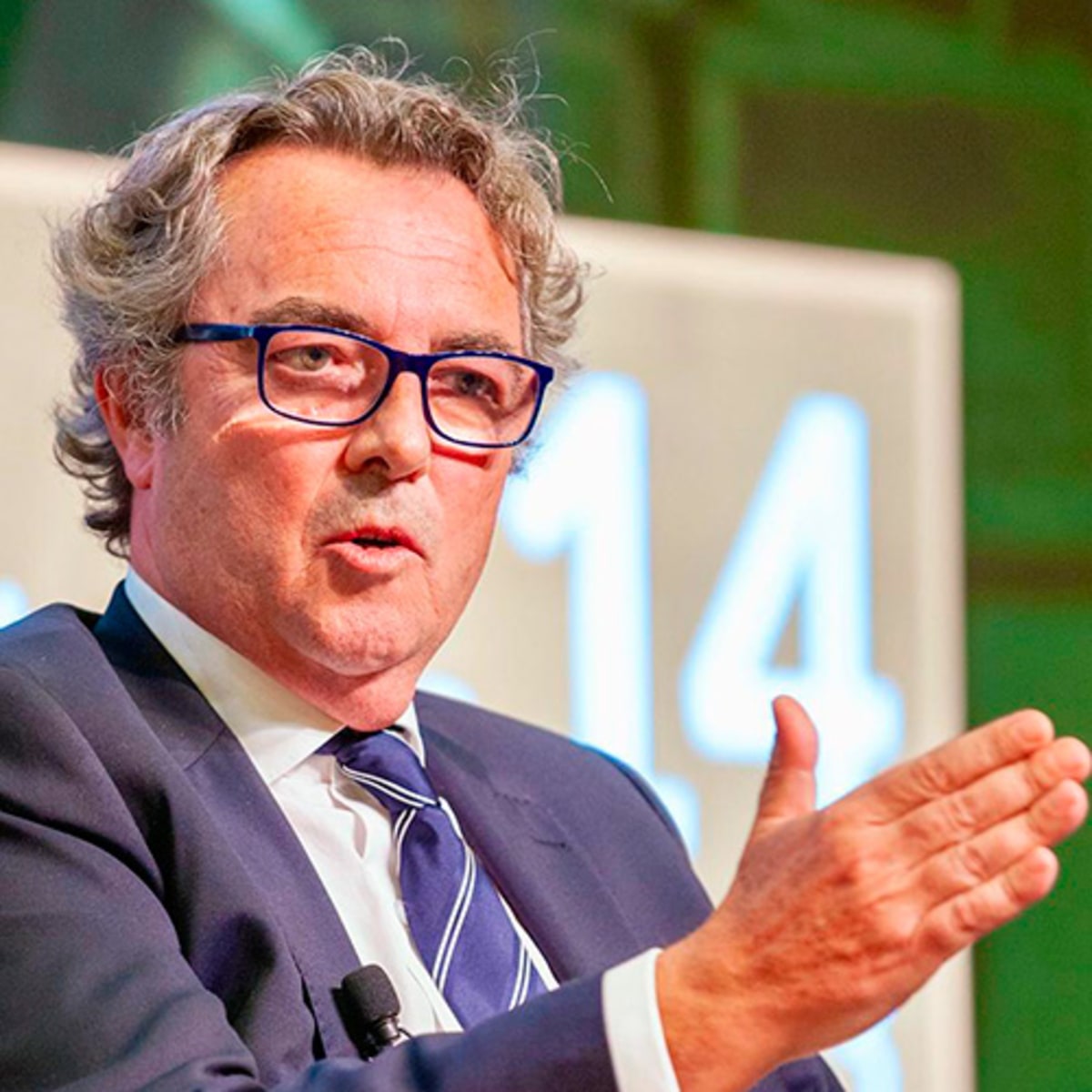
The connection between the University of Salamanca and Cajal’s legacy is manifested through figures who embody research excellence. Perhaps the strongest bridge in this relationship is embodied by Dr Andrés Chordi Corbo, Professor of Microbiology and Doctor in Medicine.
Dr Chordi Corbo represents the continuity of the School of Salamanca’s values in contemporary science. Awarded the Santiago Ramón y Cajal Prize in 1969 for his work Antígenos de la fracción subcelular (Antigens of the Subcellular Fraction), his career has been an example of the indomitable will that Cajal himself so ardently preached. Recognised with the Medal of the University of Salamanca, Chordi Corbo has been a key figure in the internationalisation of Spanish medical research, introducing pioneering immunological tests in Europe.
Today, after a life devoted to teaching and having held positions of the highest responsibility such as that of Rector of the University of Extremadura, Dr Chordi Corbo remains linked to his alma mater as a lecturer with Special Distinction. His role as Honorary President of the two Salamanca: For Cajal and Science tributes ensures that the dialogue between Vitoria’s juridical reason and Cajal’s scientific precision continues to inspire new generations.
Salamanca: sanctuary of science and of Cajal
The commemoration of the Fifth Centenary is a commitment to the future. The Declaration of Salamanca for Science seeks for 17 October to be recognised as a national holiday and the Day of Cajal. This initiative unites the rigour of the theologians of old with the microscopic precision of the sage.
| Parallels of excellence | School of Salamanca / Santiago Ramón y Cajal / Indomitable will |
|---|---|
| Independence of judgement | Challenge to divine sovereignty · Perseverance in the face of difficulty |
| Universal legacy | Cradle of international law · Father of neuroscience |
| Bond with USAL | Foundation in Vitoria’s chair · Gold Medal and affiliated lecturer |
Epilogue: science as a collective endeavour
Santiago Ramón y Cajal affirmed that “scientific discoveries constitute a collective endeavour in which it is often difficult to attribute the merit to a single scholar” (“los descubrimientos científicos constituyen una labor colectiva en la que con frecuencia es difícil atribuir el mérito a un sabio determinado”). Likewise, the School of Salamanca was a community of thought, a chorus of voices that sought justice amid the fog of history.
The gathering of 17 March is an invitation to immerse oneself in this Cajalian and Salamancan dataverse. It is a call to recover enthusiasm and to understand that only tenacious action in pursuit of truth justifies living. For in Salamanca, science and law are not watertight disciplines but the two wings with which the butterflies of the soul take flight toward excellence.
Attend. Listen. Debate. For only the person who knows how to change their mind is worthy of veneration and wonder.