Jesús Martínez Frías¹ and Joaquín González del Pino² ¹CSIC, Royal Academies of Sciences and Doctors of Spain and Distinguished Cajalian ²President, Quixote Innovation
We are currently developing a novel scientific and outreach initiative in Almagro (Ciudad Real), which is bringing about the real fusion of the already existing symbolic and cultural combination between two worlds: Earth and Mars, and two universes: the Cajalian and the real. This initiative also represents a meeting point in space and time for Cajal and Cervantes: two colossal figures of our cultural and scientific history, whose boundaries extend beyond the frontiers of our planet. And we shall see that this is real, for invisible links exist between them, both in terms of vital attitudes and in relation to the most innovative and avant-garde projects concerning space exploration, specifically Mars.
It would be presumptuous to address here, in detail and exhaustively, this web that connects them—the fruit of scientific activities and collaborations going back 15 years—but we do think it is worth providing some brushstrokes about the project that arises from them and is already under development in Almagro (Ciudad Real).
In order to bring both figures together, it must be said that Cajal was a great reader and admirer of Cervantes, especially in his fascination with “quixotism” as an attitude toward the “space” of the impossible. In 1905, on the occasion of the third centenary of the publication of Don Quixote, he delivered a famous speech at the Medical College of Madrid: “Psychology of Don Quixote and Quixotism.” In it he analysed the character as a symbol of idealism, perseverance, and struggle against the impossible, presenting him as a model for scientists. Indeed, Cajal self-identified with quixotism (“the Don Quixote of the microscope,” Williams, 1955). For him, the true scientist had to possess that quixotic attitude: pursuing elevated ideals, even though they might seem unattainable, in a “space” of difficulties, scepticism, and material limitations (as happened to him in the Spain of his era). We think that, in a certain way, to do science in Spain, we have all felt, at some point, a bit like Don Quixote. Cajal also loved the universe, as has been described on several occasions: he bought a telescope, made annotations in astronomy books, and even wrote science fiction stories (Martínez-Frías, 2025a and b, Adserias, 2025), and it is a fact that decades after his death on 17 October 1934, our illustrious Nobel laureate is transcending the frontiers of Earth and projecting himself toward the cosmos in various ways (with an asteroid and lunar crater bearing his name and, recently, by sending his name to the Moon on the Artemis II mission, Martínez-Frías, 2026). For all these reasons, we believe that the initiative we are developing in Almagro would be of his interest for what it represents, connecting the brain and Mars.
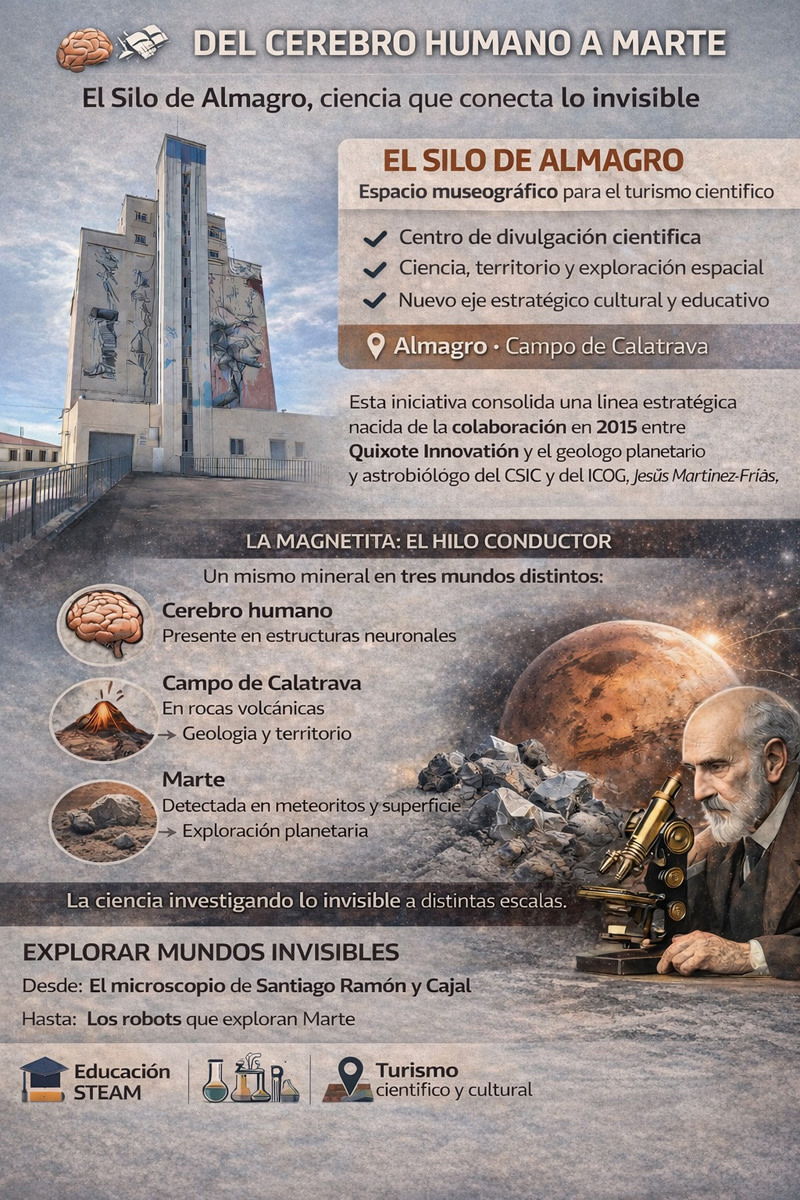
As explained in the journal Tierra y Tecnología of the Illustrious Official College of Geologists, El Silo de Almagro is advancing toward the creation of a national reference space that connects the volcanic territory with Mars exploration and the scientific legacy of our illustrious Nobel laureate. This initiative consolidates a strategic line born from the collaboration in 2015 between Quixote Innovation and Mars-related research carried out as early as 2010 by the co-author of this article, connecting this volcanic zone with the Red Planet through the Curiosity rover. The Mars–Campo de Calatrava link was proposed as a scientific and outreach line of work even before the approval of the Geopark (today a reality), proposing the territory as a terrestrial analogue for the study of Martian processes and conducting tests of the prototype ground temperature sensor of the REMS station aboard the rover at the Yezosa Volcano (Almagro).
In this context, Almagro projects a pioneering space that connects volcanic territory, planetary geology, astrobiology, and the figure of Ramón y Cajal.
A year ago, Quixote Innovation presented to the Provincial Council a proposal to incorporate a museographic space in El Silo that would reinforce this strategic axis. At the inaugural lecture of the Geopark, held at the Palacio de la Diputación, some of these comparative planetology relationships were already explained, in which the Campo de Calatrava is an important analogue. This connection constitutes “frontier science” from the volcanic heart of Spain.
The incorporation of the exhibition module we propose, entitled: “Santiago Ramón y Cajal and Mars: exploring invisible worlds,” will enable the articulation of a singular narrative in Spain: the link between the territory, space exploration, and the greatest reference in Spanish neuroscience.
One of the narrative axes will rest on a concrete scientific element: magnetite, a mineral present in the human brain, in the volcanic rocks of the Campo de Calatrava, and also on Mars, in different contexts. This bridge allows us to explain how science investigates the invisible at different scales: from Cajal’s microscope to Martian meteorites and the robots that explore the Red Planet.
In Spain we have extraordinary geodiversity, with areas such as Lanzarote, Río Tinto, El Jaroso, and Almagro that have been used as planetary analogues (mainly in relation to Mars). The Campo de Calatrava is one of these exceptional territories from a geological, astrobiological, and general scientific standpoint. Its volcanism makes it a natural laboratory that helps us understand processes we study on Mars. Integrating this reality in an outreach capacity in El Silo de Almagro, connecting it with the universal figure of Ramón y Cajal, allows us to explain how science explores the invisible, from the brain to other planets.
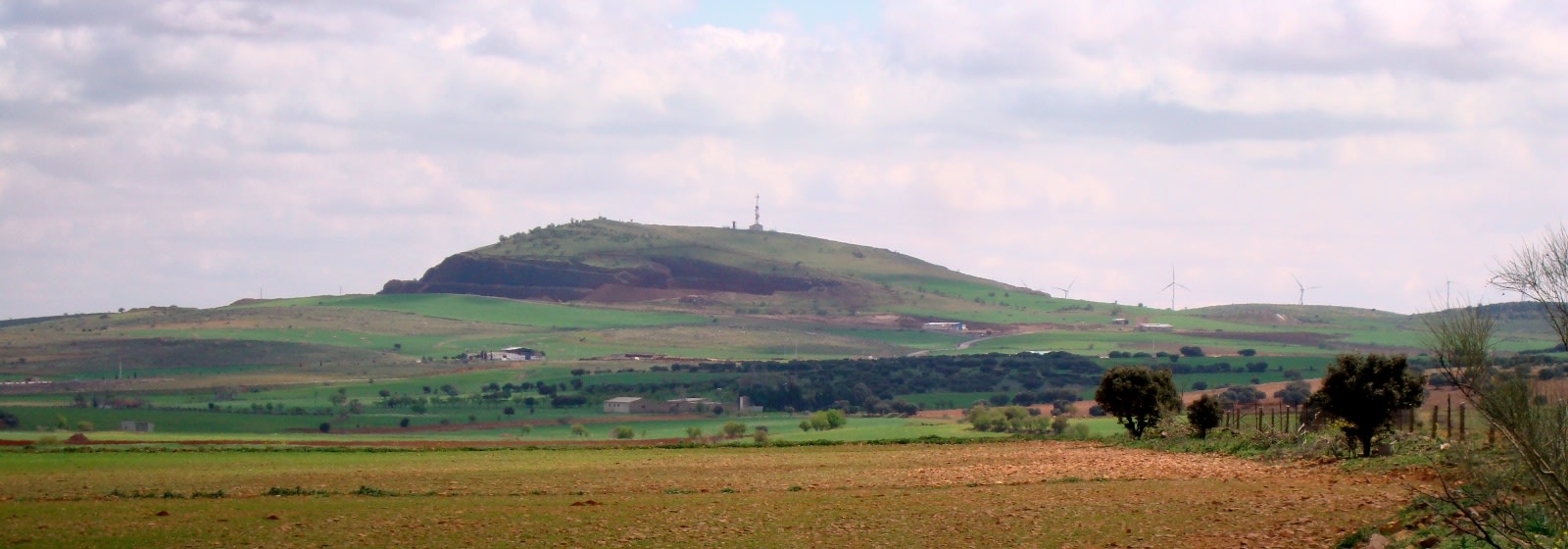
Beyond the exhibition project, this pioneering initiative is a long-term commitment. The project envisages:
-
a) a STEAM educational programme for schools;
-
b) outreach activities linked to Mars and volcanism; and
-
c) possible collaborations with universities and research centres.
In short, El Silo de Almagro aspires to become a national node connecting territory, science, and the future, where Cajal will constitute one of the fundamental modules.
In the future, Cajal will be present on and will reach Mars, just as he has reached the asteroids and the Moon. But for the moment, he is already at a Martian analogue here on Earth, in conjunction with Cervantes—for, as is well known, Almagro has become one of the emblematic places of Quixotic culture thanks to its theatrical heritage, the Festival of Classical Theatre, and its integration into the tourist routes of La Mancha. We are convinced that both would love this connection.