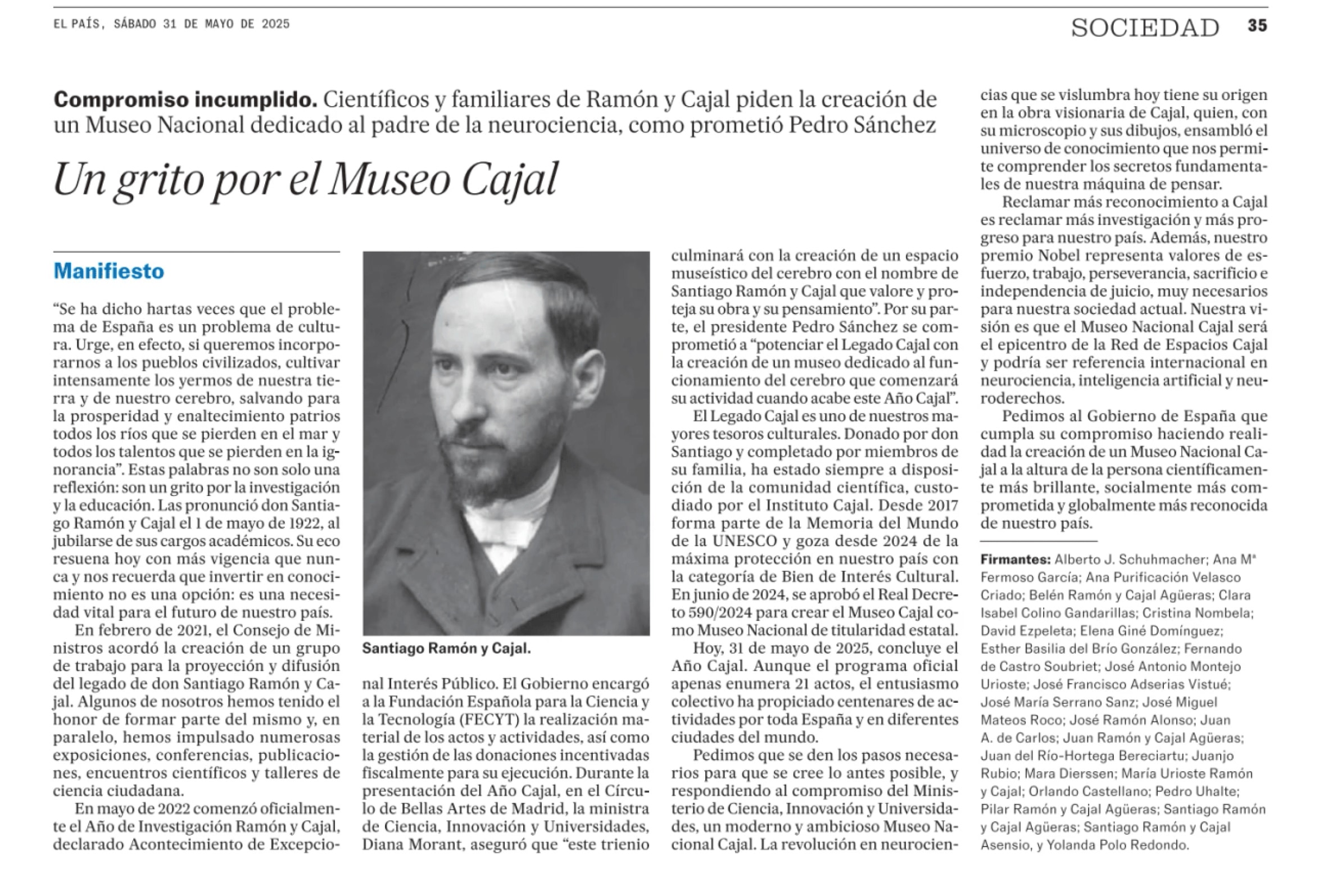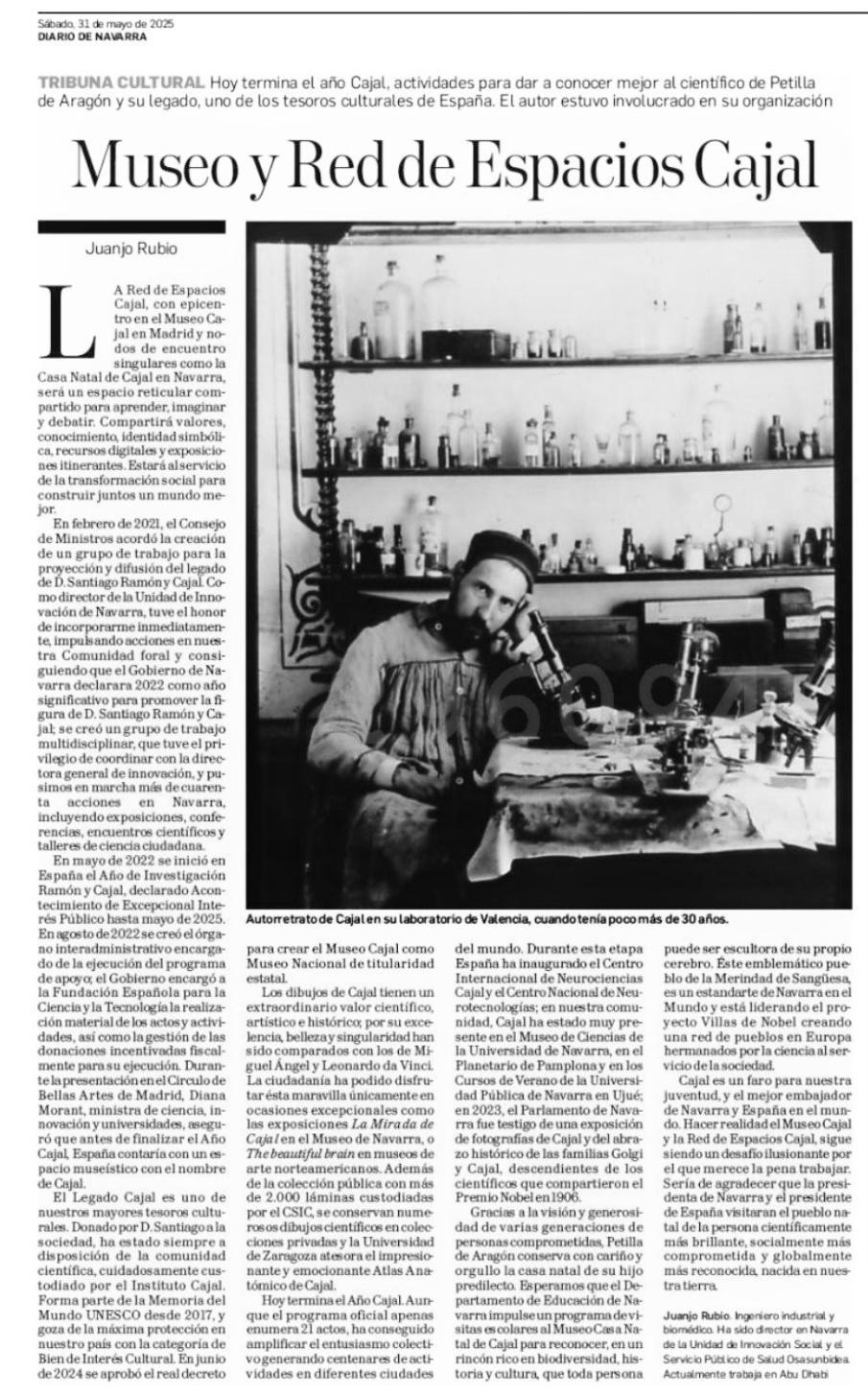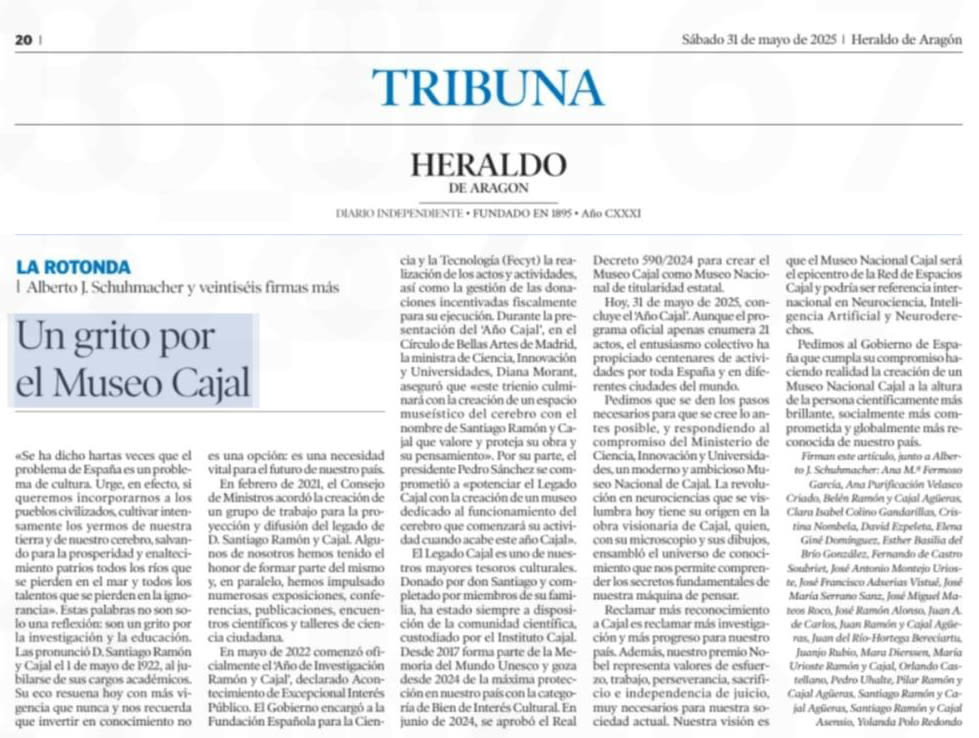
«It has been said many times that Spain’s problem is a problem of culture. It is urgent, indeed, if we wish to join the ranks of civilized nations, to intensively cultivate the barren lands of our soil and of our brain, saving for the prosperity and exaltation of our country all the rivers that are lost in the sea and all the talents that are lost in ignorance» (“Se ha dicho hartas veces que el problema de España es un problema de cultura. Urge, en efecto, si queremos incorporarnos a los pueblos civilizados, cultivar intensamente los yermos de nuestra tierra y de nuestro cerebro, salvando para la prosperidad y enaltecimiento patrios todos los ríos que se pierden en el mar y todos los talentos que se pierden en la ignorancia”).
These words are not merely a reflection: they are a cry for research and education. They were spoken by Don Santiago Ramón y Cajal on May 1, 1922, upon retiring from his academic positions. Their echo resonates today with more relevance than ever, reminding us that investing in knowledge is not an option: it is a vital necessity for the future of our country.
In February 2021, the Council of Ministers agreed to create a working group for the promotion and dissemination of the legacy of Don Santiago Ramón y Cajal. Some of us have had the honor of being part of it and, in parallel, have promoted numerous exhibitions, lectures, publications, scientific meetings, and citizen science workshops.
In May 2022, the “Ramón y Cajal Research Year” officially began, declared an Event of Exceptional Public Interest. The Government entrusted the Spanish Foundation for Science and Technology (FECYT) with the material execution of the events and activities, as well as the management of tax-incentivized donations for their implementation. During the presentation of the “Cajal Year” at the Círculo de Bellas Artes in Madrid, the Minister of Science, Innovation, and Universities, Diana Morant, assured that «this triennium will culminate with the creation of a museum space of the brain bearing the name of Santiago Ramón y Cajal that will value and protect his work and his thought» (“este trienio culminará con la creación de un espacio museístico del cerebro con el nombre de Santiago Ramón y Cajal que valore y proteja su obra y su pensamiento”). For his part, President Pedro Sánchez committed to «strengthening the Cajal Legacy with the creation of a museum dedicated to the functioning of the brain that will begin its activity when this Cajal Year ends» (“potenciar el Legado Cajal con la creación de un museo dedicado al funcionamiento del cerebro que comenzará su actividad cuando acabe este año Cajal”).
The Cajal Legacy is one of our greatest cultural treasures. Donated by Don Santiago and supplemented by members of his family, it has always been available to the scientific community, safeguarded by the Cajal Institute. Since 2017, it has been part of the UNESCO Memory of the World and since 2024 enjoys the highest level of protection in our country with the designation of Asset of Cultural Interest. In June 2024, Royal Decree 590/2024 was approved to create the Cajal Museum as a National Museum under state ownership.
Today, May 31, 2025, the “Cajal Year” comes to a close. Although the official program lists only 21 events, collective enthusiasm has given rise to hundreds of activities throughout Spain and in different cities around the world.
We call for the necessary steps to be taken so that a modern and ambitious Cajal National Museum is created as soon as possible, fulfilling the commitment of the Ministry of Science, Innovation, and Universities. The revolution in neuroscience that is taking shape today has its origin in the visionary work of Cajal who, with his microscope and his drawings, assembled the universe of knowledge that allows us to understand the fundamental secrets of our thinking machine.
To demand greater recognition for Cajal is to demand more research and more progress for our country. Moreover, our Nobel laureate represents values of effort, hard work, perseverance, sacrifice, and independence of judgment that are sorely needed in our society today. Our vision is that the Cajal National Museum will be the epicenter of the Network of Cajal Spaces and could become an international reference in Neuroscience, Artificial Intelligence, and Neurorights.
We call upon the Government of Spain to fulfill its commitment by making a reality the creation of a Cajal National Museum worthy of the most scientifically brilliant, socially committed, and globally recognized person in our country.
-
Alberto Anaya Munné. Former professor at the State University of New York and the Autonomous University of Madrid. Ramón y Cajal Prize 2001 of the Spanish Society of Anatomical Pathology.
-
Alberto J. Schuhmacher. ARAID Researcher and Center for Cajalian Studies.
-
Ana María Fermoso García. Vice-Rector for Research and Transfer at the Pontifical University of Salamanca.
-
Ana María Puras Gil. Former President of the Spanish Society of Anatomical Pathology.
-
Ana Purificación Velasco Criado. Associate Professor of Biochemistry and Molecular Biology at the University of Salamanca.
-
Andrés Celestino García Montero. Researcher at the Biomedical Research Institute of Salamanca (IBSAL).
-
Belén Ramón y Cajal Agüeras.** **Ramón y Cajal Family.
-
Bertha Gutiérrez Rodilla. Vice-Rector for Undergraduate Studies and Quality at the University of Salamanca.
-
Chon Ubieto Ubieto. Retired.
-
Clara Isabel Colino Gandarillas.** **Dean of the Faculty of Pharmacy at the University of Salamanca.
-
Cristina Nombela. Associate Professor at the Autonomous University of Madrid.
-
David Ezpeleta. Vice-President of the Spanish Society of Neurology.
-
Diego Gómez Fernández. Lawyer and professor of the Master’s in Law Practice at the University of Vigo.
-
Elena Giné Domínguez. Associate Professor at the Complutense University of Madrid.
-
Emilio Ubieto Ausere. Retired.
-
Esther Basilia del Brío González. Senator of Spain.
-
Federico Bueno de Mata. Vice-Rector for Transfer, Innovation, and Entrepreneurship.
-
Felipe Francisco Chaneta Garau. Lawyer.
-
Fernando de Castro Soubriet. Tenured Scientist at the CSIC. Cajal Institute.
-
Fernando Luis Fontes Blanco. Director of the National Museum of Science and Technology.
-
Florentino Aguas Arilla. Mayor of the village of Petilla de Aragón.
-
Javier García de la Cruz. Director of Development and Business at Asercomex Logística Pharma.
-
Jorge Hernández García. Project Manager, Vice-Rectorate for Internationalization and Cooperation at the University of Salamanca.
-
**José Antonio Montejo Urioste. **Ramón y Cajal Family.
-
José Fco. Adserias Vistué. Director at Por Cajal y la Ciencia.
-
José Manuel Porcel Pérez. Vice-President of the Spanish Society of Internal Medicine.
-
**José María Serrano Sanz. **Professor of Applied Economics at the University of Zaragoza.
-
José María Mur Bernad. Former President of the Cortes of Aragón and former Senator of Spain.
-
José Miguel Mateos Roco. Vice-Rector for Research at the University of Salamanca.
-
José Ramón Alonso Peña. Professor of Neuroscience at the University of Salamanca.
-
**Juan A. de Carlos. **Scientific Director of the Cajal Legacy. Cajal Institute.
-
Juan Ramón y Cajal Agüeras. Ramón y Cajal Family.
-
Juan del Río-Hortega Bereciartu. University of Valladolid.
-
Juanjo Rubio. Former Director of the Navarra Health Service.
-
Manuel Garrosa. President of the Spanish Society of Histology and Tissue Engineering.
-
Manuel Moreno Valladares. Pathologist at Hospital Universitario Donostia / Biogipuzkoa Institute.
-
Mara Dierssen. President of the Spanish Brain Council.
-
María del Carmen Urtasun Yangüas. Nursing graduate and Osasunbidea healthcare worker.
-
María Urioste Ramón y Cajal. Marquise of Ramón y Cajal.
-
Marta Rezola Bajineta. Pathologist and Section Head at Hospital Universitario Donostia.
-
Miguel Ángel Pérez Lucas. Director of Communications at the National Hospital of Paraplegics.
-
Nuria Anaya Reig. Professor at Rey Juan Carlos University.
-
Luis Aguilar Mendoza. President of the Peruvian Society for Neuroscience.
-
Orlando Castellano Benítez. Contracted Doctor Professor at the University of Salamanca.
-
Pedro Uhalte Sevilla. Curator of the Cajal Birthplace Museum.
-
Pilar España Sanz. Oncologist.
-
Pilar Ramón y Cajal Agüeras. Ramón y Cajal Family.
-
Santiago Ramón y Cajal Agüeras. Ramón y Cajal Family.
-
Santiago Ramón y Cajal Asensio. Ramón y Cajal Family.
-
Yolanda Polo Redondo. Vice-Rector for Culture and Social Outreach at the University of Zaragoza.
Read the Tribune in El País (print version
.pdf — Docs.Santiagoramonycajal
If you wish to join, leave your name and affiliation in the comments. Thank you very much.
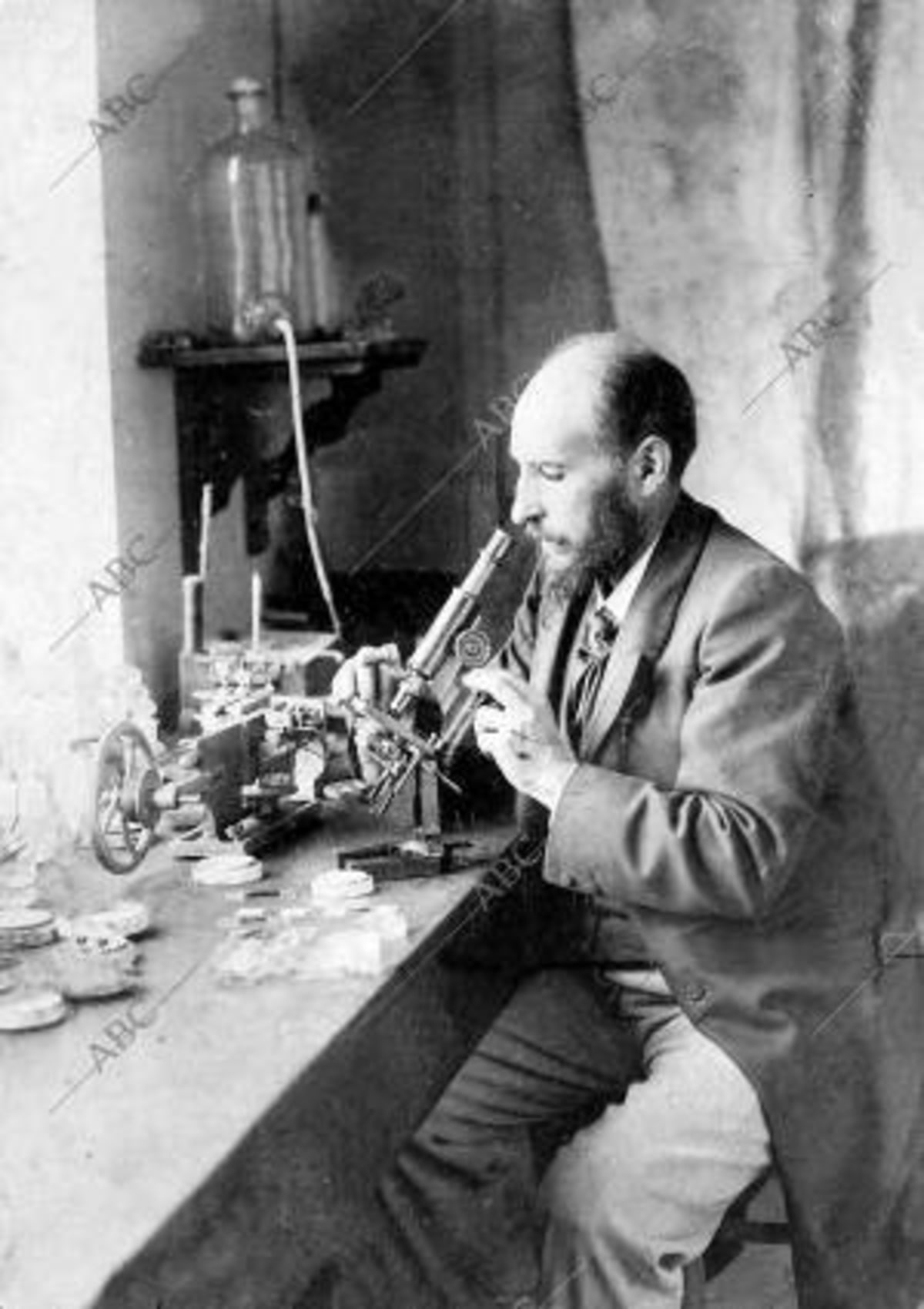
© Self-portrait of Cajal in his laboratory in Valencia circa 1885, colorized by Rafael Navarrete.