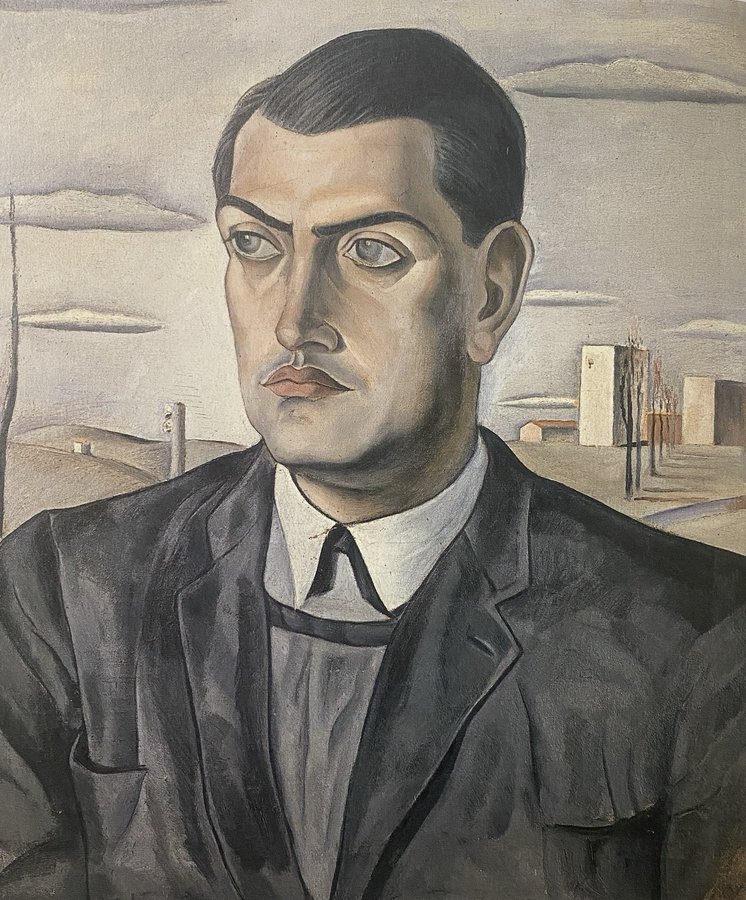
 Portrait of Luis Buñuel, 1924. Salvador Dalí. More information.
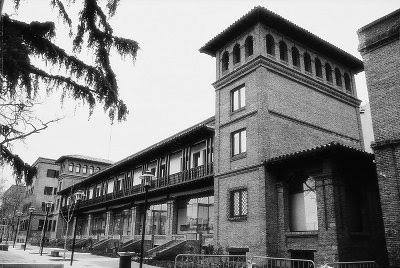
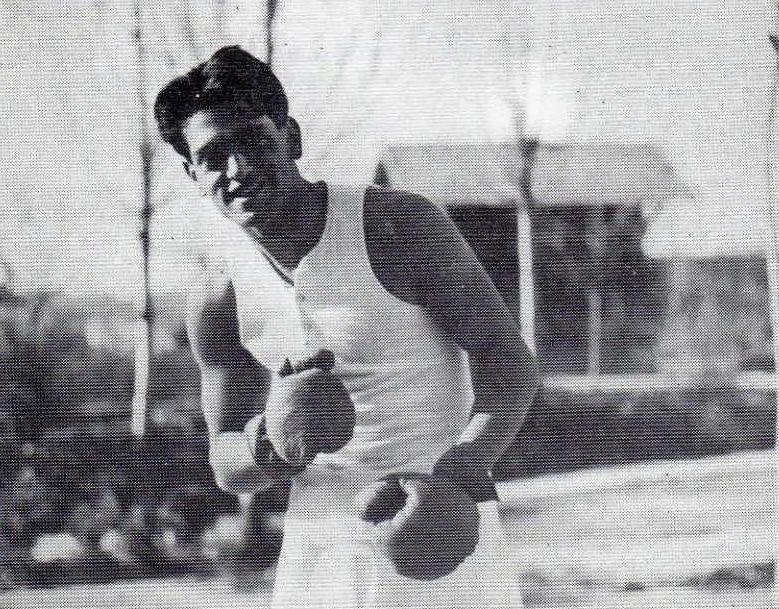
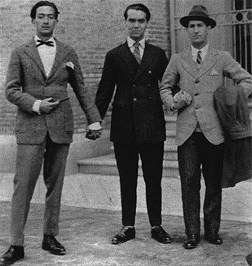
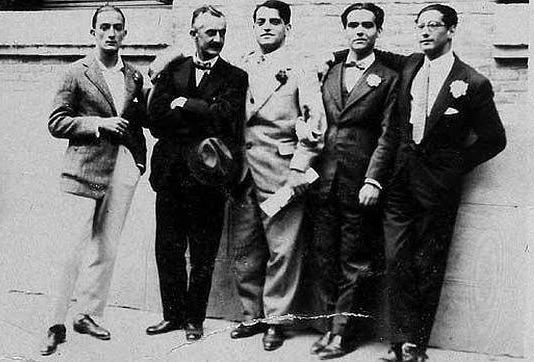
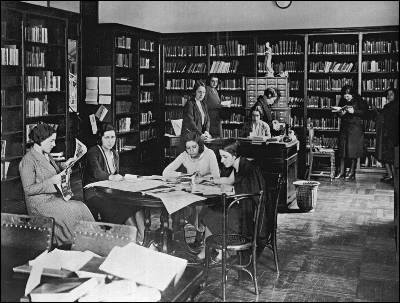
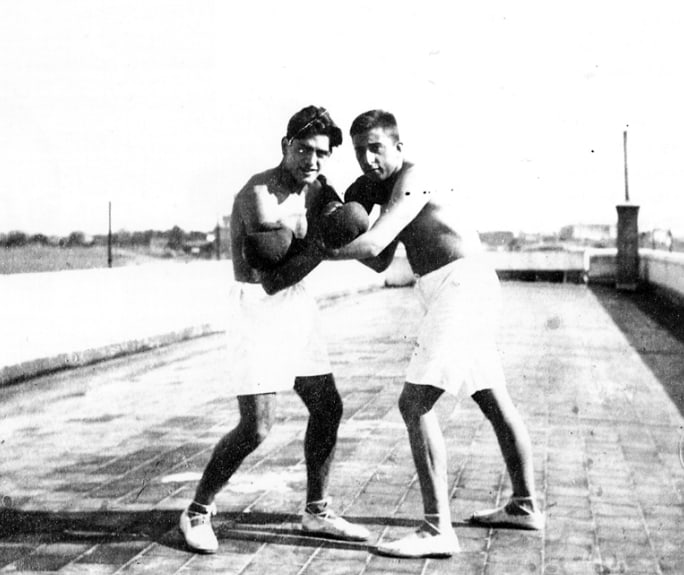
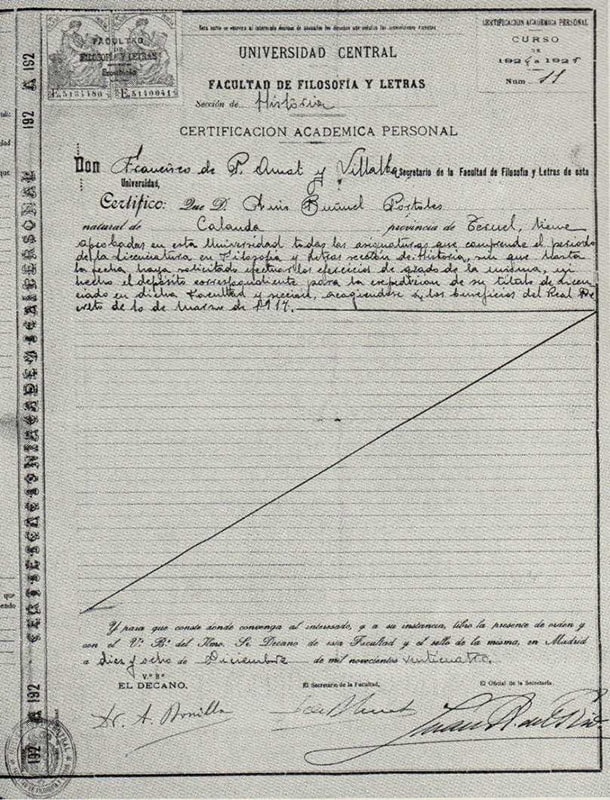
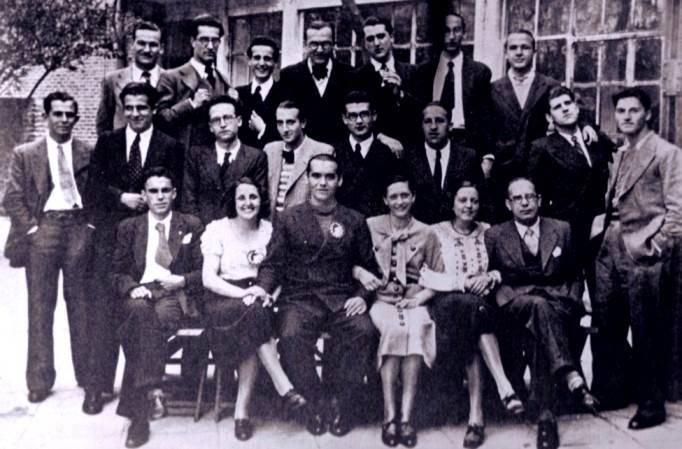
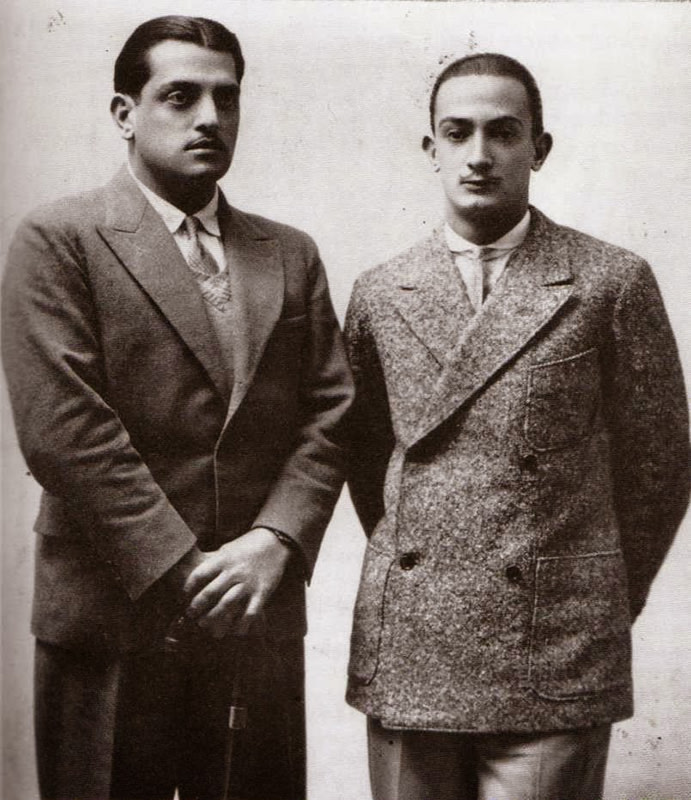
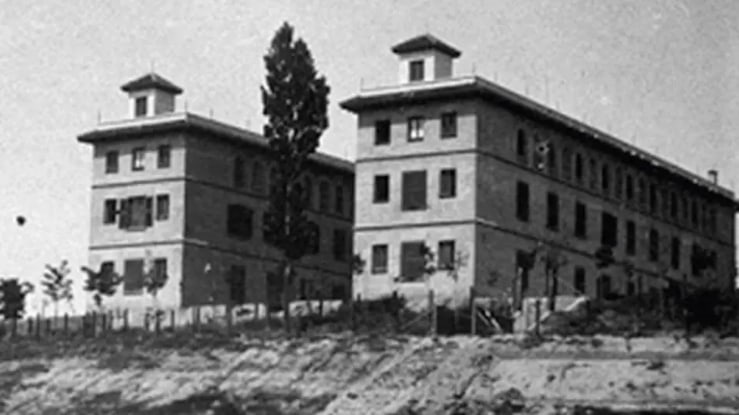
Luis Buñuel Portolés recounts: “Thanks to the recommendation of a senator, Don Bartolomé Esteban, I was enrolled at the Student Residence, where I would remain for seven years. My memories of that time are so rich and vivid that I can assure, without fear of being wrong, that, had I not passed through the Residencia, my life would have been very different.” («Gracias a la recomendación de un senador, don Bartolomé Esteban, me inscribieron en la Residencia de Estudiantes, donde permanecería siete años.»)
My Last Sigh (Mi último suspiro). p. 43 Luis Buñuel
“At the Student Residence I found myself facing an inevitable choice. That choice was influenced by the environment I lived in, the literary movement that existed in Madrid at the time, and the encounter with some excellent friends. At what moment was my life decided? Today it is almost impossible to determine.”
My Last Sigh. p. 45 Luis Buñuel
“I was at the Student Residence from 1917 to 1924, the year I left for Paris. Those seven years were very important for my formation. I went from agronomy to natural sciences and finally to philosophy and letters. Although ‘I studied very little, this degree, which normally took four years, I completed in two. It was all about going to cafés and chatting with friends. Gatherings of a warm, wonderful friendship. We did foolish things. For example: we dressed up in costumes. We went to Toledo to get drunk for five days, until we kissed the Toledan stones.’”
Buñuel by Buñuel (Buñuel por Buñuel). p. 18 Tomás Pérez Turrent and José de la Colina
“The most important literary cafés in Madrid were the ‘Café Gijón,’ which still exists, the ‘Granja del Henar,’ the ‘Café Castilla,’ ‘Fornos,’ ‘Kutz,’ the ‘Café de la Montaña,’ where they had to replace the marble-topped tables, so much had the artists dirtied them (I went every afternoon after classes to continue studying), and the ‘Café Pombo,’ where Gómez de la Serna held court on Saturday nights. We would arrive, greet each other, sit down, order drinks—almost always coffee and lots of water (the waiters never stopped bringing water)—and a wandering conversation would begin: literary commentary on the latest publications, the latest readings, political news. We lent each other foreign books and magazines. We criticized the absent. Sometimes, an author would read a poem or an article aloud and Ramón would give his opinion, always listened to and, on occasion, debated. Time passed quickly. More than one night, a few friends continued talking as we wandered through the streets.
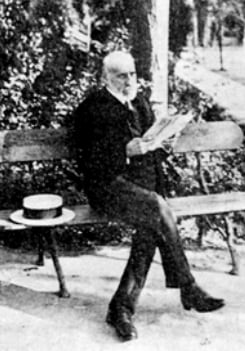
The neurologist Santiago Ramón y Cajal, Nobel Prize winner and one of the greatest scholars of his time, went every afternoon to the ‘Café del Prado’ and sat alone at a table in the back. In that same café, a few tables away, a group of ultraist poets met, of which I was a member.
A friend of ours, the journalist and writer Araquistain (whom later, during the Civil War, I would encounter as ambassador in Paris), bumped into a certain José María Carretero on the street, a novelist of the lowest sort, a two-meter giant who signed his works with the pseudonym the Bold Knight (el Caballero Audaz). Carretero grabbed Araquistain by the lapels, insulting him and reproaching him for a certain unfavorable article our friend had dedicated to him (with very good reason). Araquistain responded with a slap and passersby had to separate them.
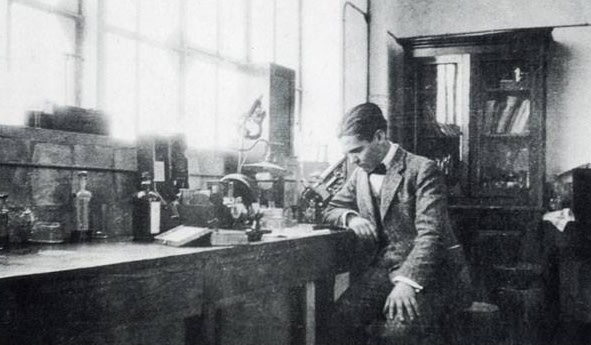
The case caused quite a stir in the literary world. We decided to hold a tribute banquet for Araquistain and collect signatures in his support. My ultraist friends, knowing that I knew Cajal from the Natural History Museum, where I prepared slides for the microscope in the Entomology section, asked me to request his signature, which would have been the most prestigious of all.
I did so. But Cajal, already very old, refused to sign, offering the excuse that the newspaper ABC, in which the Bold Knight was a regular contributor, was going to publish his own Memoirs and he feared that, if he signed, the newspaper might rescind the contract.
I, too, though for different reasons, always refuse to sign the petitions presented to me. Signature sheets serve only to ease one’s conscience. I know my attitude is debatable. Therefore, if something happens to me, if I am thrown in prison, for example, or disappear, I ask that no one sign for me.”
My Last Sigh. pp. 50–51 Luis Buñuel
“I cannot explain day by day what those years of formation and encounters were like; our conversations, our work, our walks, our drinking bouts, the brothels of Madrid (the best in the world, without a doubt) and our long evenings at the Residencia.”
My Last Sigh. p. 54 Luis Buñuel
In 1920, he decided to switch to Natural Sciences, a discipline for which he had always felt a deep passion… For nearly two years he worked under the orders of the famous researcher and orthopterologist Ignacio Bolívar, whose laboratory at the Natural History Museum was very close to the Residencia. During that time he prepared numerous histological preparations of insects for Santiago Ramón y Cajal. What made him change his course of study was reading the book Souvenirs Entomologiques by the famous entomologist Jean-Henri Fabre. Even today I can recognize many insects at first glance and give their names in Latin.
Buñuel tells us about his relationship with Santiago Ramón y Cajal
Buñuel at the Student Residence. Aragón Radio
The Order of Toledo: Avant-Garde and Mysticism
In 1923, Luis Buñuel founded the “Order of Toledo,” a sort of playful and bohemian brotherhood that organized weekend excursions to the imperial city. Among its founding members were Lorca, Dalí, Rafael Alberti, and Pepín Bello. The Order had its own rituals and precepts: to be named a “knight,” one had to love Toledo unreservedly, wander alone through its streets for an entire night, get drunk, and not wash during the stay. They stayed at the modest Posada de la Sangre, where it was said that Cervantes had written The Illustrious Kitchen Maid, and they sought inspiration in the mysticism of the city and in the work of El Greco. This mixture of student revelry and a quest for a profound connection with the Castilian soul perfectly defined the spirit of the group. The history of the Order had a tragic echo during the Civil War, when an anarchist brigade found a box with documents from the “Order of Toledo” and, confusing the playful title with a noble one, executed the man who kept it.
The “Profanations” of Don Juan Tenorio and the Concept of “Putrefacto”
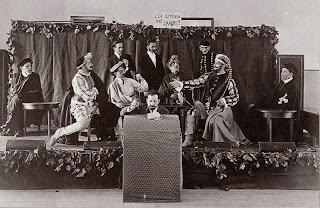
Another of the group’s most famous traditions were their delirious performances of Zorrilla’s Don Juan Tenorio, which usually took place around All Saints’ Day. They were surrealist “profanations” of the romantic classic, in which Buñuel, for example, played Don Juan armed with a typewriter to dispatch his love correspondence. These performances were an explosion of creativity and humor that subverted the cultural standards of the era. Along the same lines, the group coined the term “putrefacto” (putrid) to refer to everything they considered outdated, academic, bourgeois, and anachronistic. The “putrefactos” were the target of their mockery and represented everything against which their avant-garde spirit rebelled.
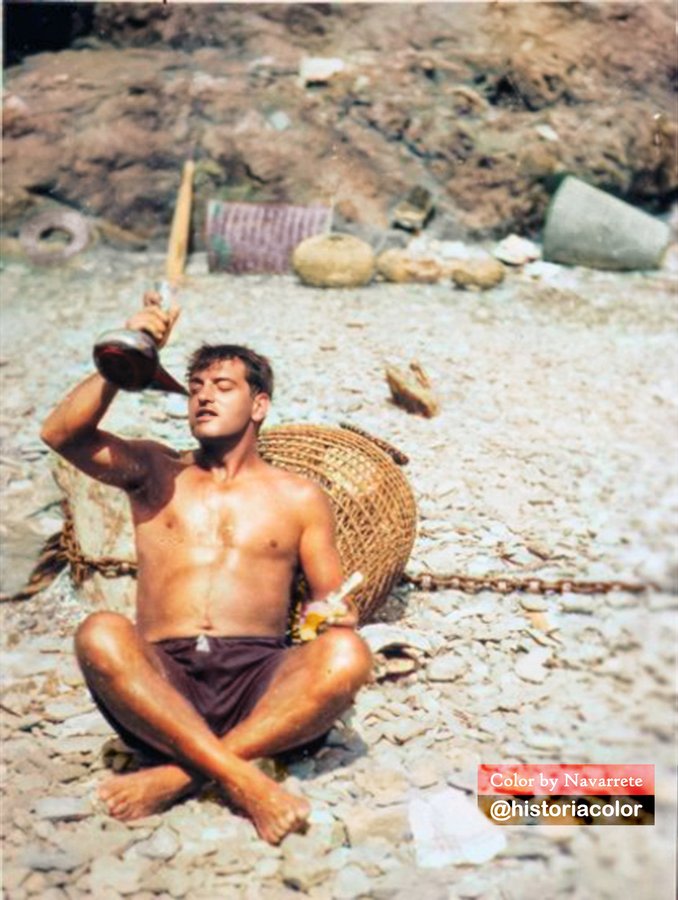 Summer of 1929 at Cap de Creus, Cadaqués. Luis Buñuel drinks wine from a porrón on the beach. That summer many things happened in the group of friends comprising Buñuel, Lorca, and Dalí. The three met at the Student Residence in Madrid and forged a great friendship. More information.
Four scenes in the life of Luis Buñuel
Four scenes in the life of Luis Buñuel. Aragón Radio
It was during his stay at the Residencia that he discovered some of the people who would most influence his life and work:
· Ramón Gómez de la Serna: His fantasy and humor, his use of metaphor, and the attention he pays to objects in his greguerías would become characteristics that would pass into Buñuel’s work. “Buñuel placed a strong bet on Ramón, who was the author of the script for his first film project. Buñuel can be considered the gifted disciple of Ramón who, unlike other members of his generation… never denied his mentorship… Six years of continuous attendance at the Pombo should absolutely not be dismissed.” He would be the first person from whom he would request collaboration for a screenplay that would never be made: Caprichos.
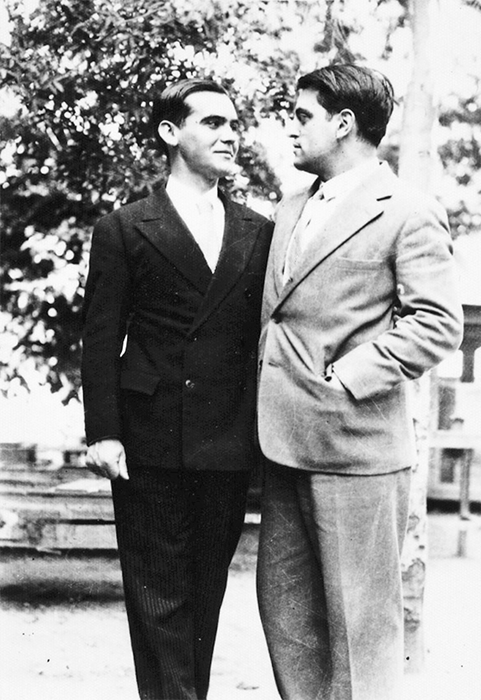
· Federico García Lorca: “Our friendship, which was profound, dates from our first meeting. Despite the fact that the contrast could not have been greater, between the rough Aragonese and the refined Andalusian—or perhaps because of this very contrast—we were almost always together. At night we would go to a vacant lot behind the Residencia (the fields then extended to the horizon), sit on the grass, and he would read me his poems. He read divinely. Through his companionship, I was gradually transformed before a new world that he was revealing to me day after day…”
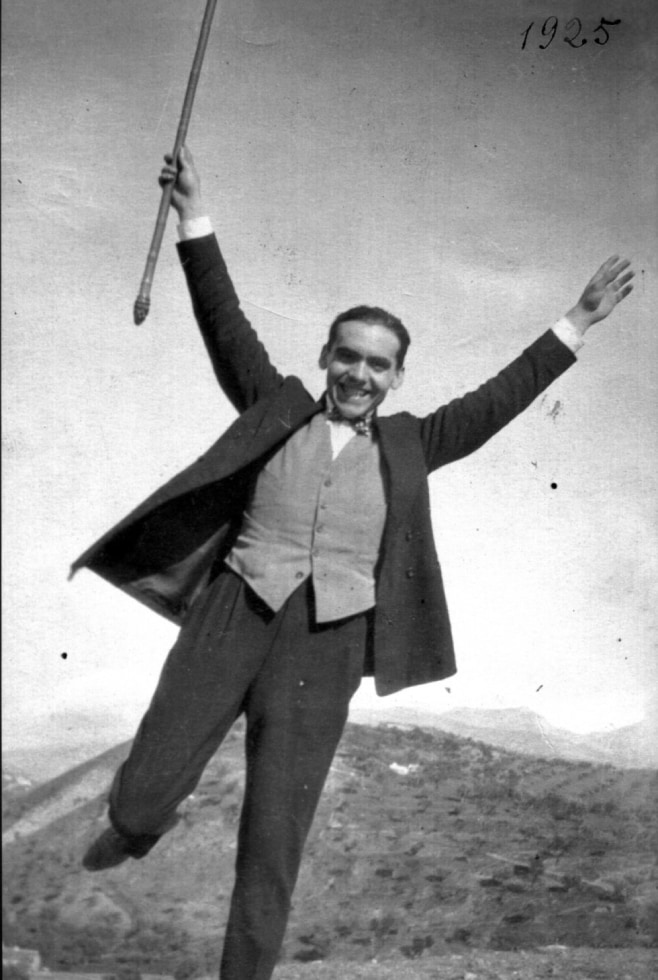
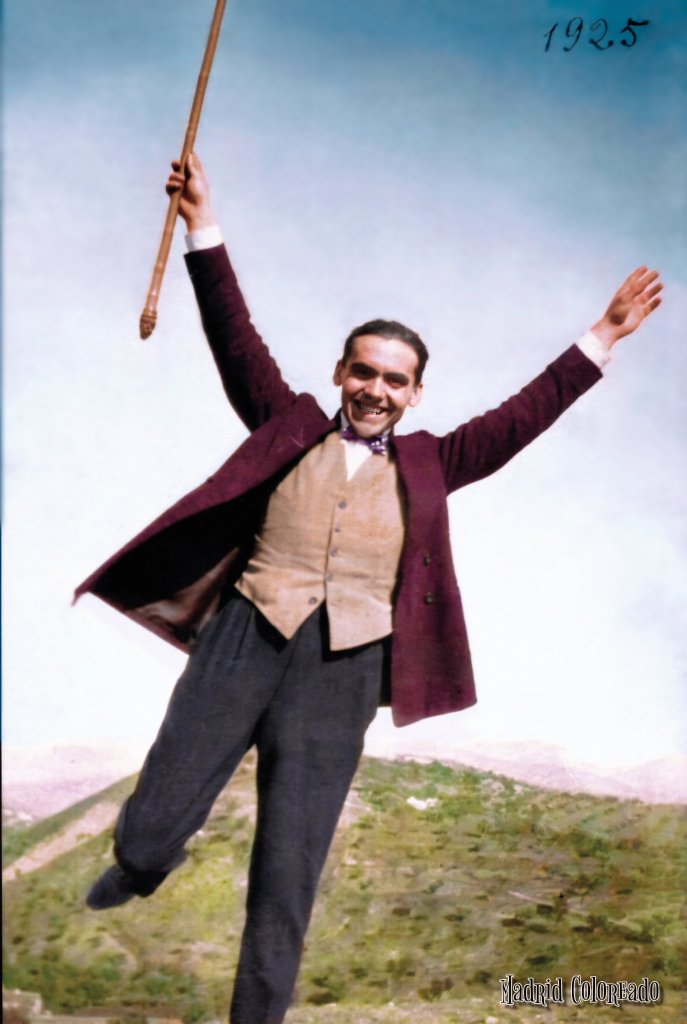
Together, the two of us alone or in the company of others, we spent unforgettable hours. Lorca made me discover poetry, especially Spanish poetry, which he knew admirably, and also other books. For example, he made me read the Golden Legend, the first book in which I found something about Saint Simeon Stylites, who later became Simon of the Desert. Federico did not believe in God, but he preserved and cultivated a great artistic sense of religion.
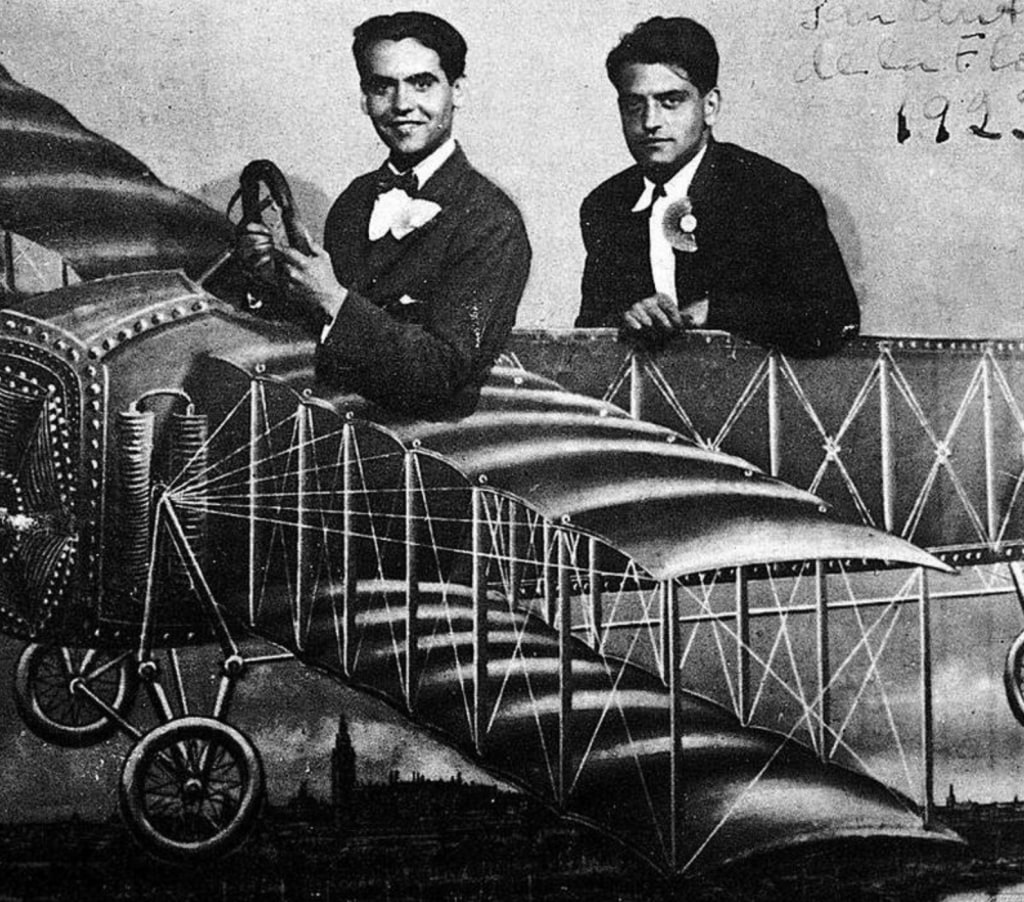
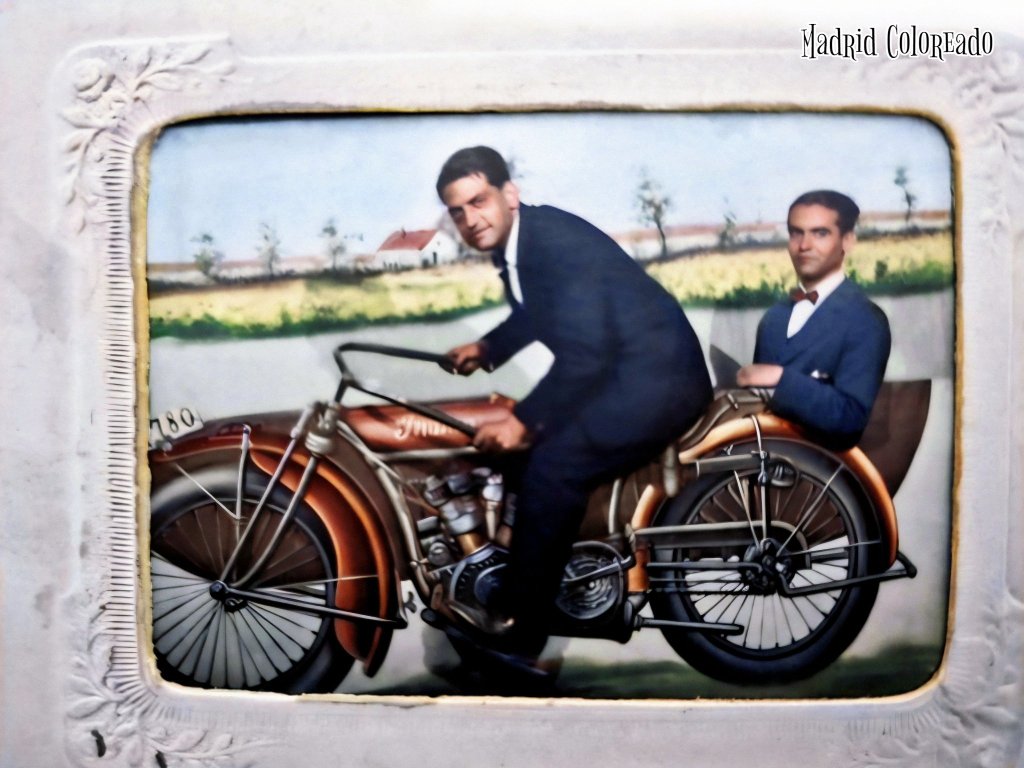
I keep a photograph in which the two of us are on a cardboard motorcycle at a photographer’s stand, in 1924, at the fiestas of the verbena of San Antonio in Madrid. On the back of the photo, at three in the morning (both drunk), Federico wrote a poem improvised in less than three minutes, and gave it to me. Time is gradually erasing the pencil and I copied it to preserve it. It reads:
The first verbena that God sends Is that of San Antonio de la Florida, Luis: in the enchantment of the dawn My friendship sings, ever in bloom, The great moon shines and rolls Through high, tranquil clouds, My heart shines and rolls In the green and yellow night, Luis, my passionate friendship Weaves a braid with the breeze. The child plays the little piano Sadly, without a smile, Under the arches of paper I clasp your friendly hand.
Federico García Lorca
Later, in 1929, in a book he gave me, he wrote some verses, also unpublished, that I like very much:
Blue sky Yellow field
Blue mountain Yellow field
Across the deserted plain An olive tree walks
A single Olive tree.
Federico García Lorca
My Last Sigh. pp. 53–54 Luis Buñuel
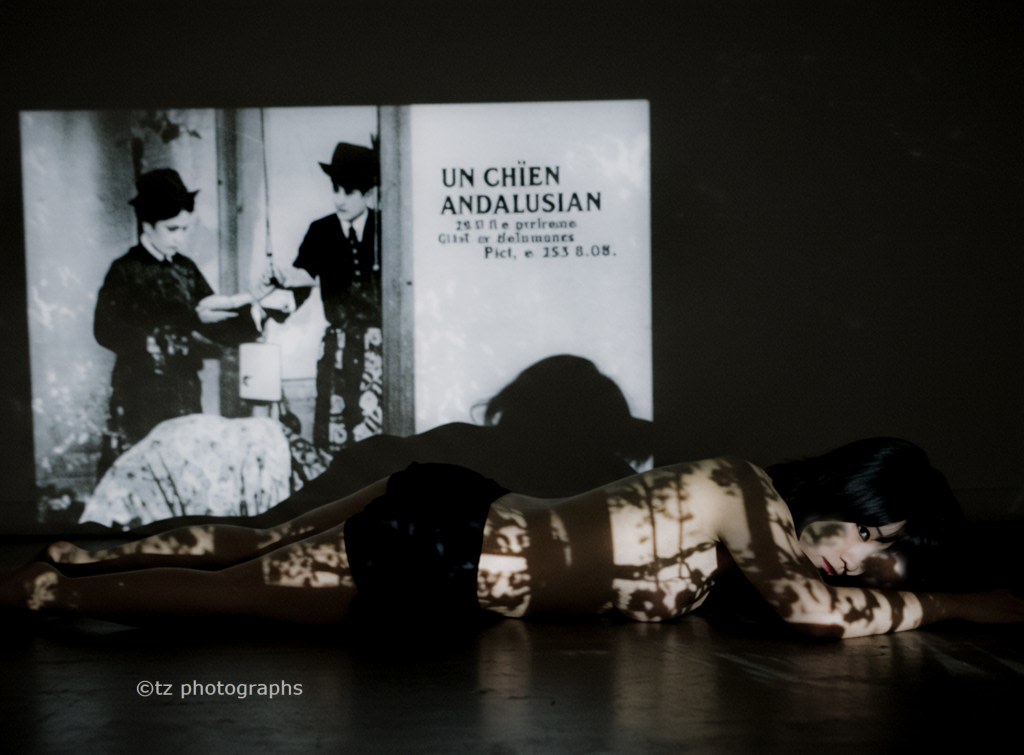
“Shortly before Un Chien Andalou, a superficial disagreement separated us for some time. Then, as an Andalusian, sensitive, he believed, or pretended to believe, that the film was directed against him. He used to say:
—Buñuel has made a little film like this (finger gesture), it’s called An Andalusian Dog, and the dog (chien) is me.
In 1934, we had completely reconciled. Although I sometimes found that he allowed himself to be submerged by too great a number of admirers, we spent long hours together. Frequently, accompanied by Ugarte, we would climb into my Ford to relax for a few hours in the Gothic solitude of El Paular. The place was in ruins, but six or seven rooms, very sparsely furnished, were reserved for the Fine Arts. One could even spend the night there, provided one brought a sleeping bag. The painter Peinado—whom forty years later I would encounter again by chance in this very place—frequently came to the old deserted monastery.
It was difficult to talk about painting and poetry when we felt the storm approaching. Four days before Franco’s landing, García Lorca—who could not be passionate about politics—suddenly decided to leave for Granada, his city. I tried to dissuade him, I told him:
—Authentic horrors are brewing, Federico. Stay here. You will be much safer in Madrid.
Other friends pressured him, but in vain. He left very nervous, very frightened.
The announcement of his death was a terrible shock for all of us.
Of all the living beings I have known, Federico is the first. I speak neither of his theater nor of his poetry, I speak of him. The masterpiece was him. It even seems difficult to find someone like him. Whether he sat at the piano to play Chopin or improvised a pantomime or a brief theatrical scene, he was irresistible. He could read anything, and beauty always flowed from his lips. He had passion, joy, youth. He was like a flame.
When I met him at the Student Residence, I was a rather rough provincial athlete. Through the strength of our friendship, he transformed me, he made me know another world. I owe him more than I could ever express.
His remains have never been found. Numerous legends have circulated about his death, and Dalí—ignobly—even spoke of a homosexual crime, which is totally absurd. In reality, Federico died because he was a poet. At that time, on the other side, one could hear the cry: ‘Death to intelligence!’ («¡Muera la inteligencia!»)
In Granada, he took refuge in the home of a Falange member, the poet Rosales, whose family was friends with his. There he believed himself safe. Some men (of what political persuasion? It matters little), led by a certain Alfonso, came to arrest him one night and made him get into a truck with several workers.
Federico had a great fear of suffering and death. I can imagine what he felt, in the middle of the night, in the truck taking him to the olive grove where they were going to kill him.
I think about that moment frequently.”
My Last Sigh. pp. 134–135 Luis Buñuel
Buñuel was a surrealist writer, not a ‘superrealist.’ That is, he was a member of the French group, not a ‘derivative’ of the Spanish group. This is fundamental and on that point he is not comparable to anyone, not even Lorca. Moreover, I think Lorca’s Poet in New York owes quite a lot to Buñuel the poet. But Buñuel had an added value compared to his French colleagues, that Spanish punch that translates into his humor, fundamental in his work, both literary and filmic.
Jordi Xifra, director of the Buñuel Center of Calanda.
· Jean Henri Fabre. Entomologist. “I have adored Fabre’s Entomological Memories. For the passion of observation, for the limitless love of living beings, this book seems to me unequalled, infinitely superior to the Bible. For a long time, I said that it was the only book I would take to a desert island. Today I have changed my mind: I would not take any book.”
My Last Sigh. p. 186 Luis Buñuel
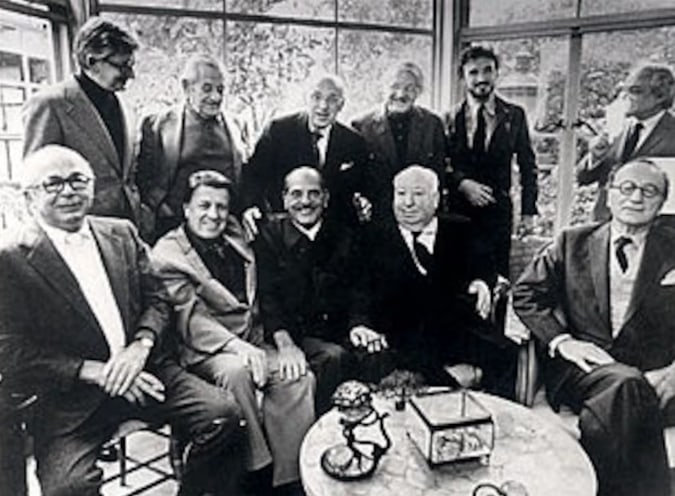
The Greatest Concentration of Cinematic Talent Ever Seen
One must have begun to lose one’s memory, even if only in fragments, to realize that memory is what constitutes our entire life. A life without memory would not be a life, just as an intelligence without the possibility of expressing itself would not be intelligence. Our memory is our coherence, our reason, our action, our feeling. Without it we are nothing. Memory, indispensable and portentous, is also fragile and vulnerable. It is threatened not only by forgetting, its old enemy, but also by the false memories that invade it day after day… Memory is continually invaded by imagination and daydream, and since there is the temptation to believe in the reality of the imaginary, we end up making a truth of our lie. Which, on the other hand, is only of relative importance, since one is just as vital and personal as the other.
My Last Sigh (Mon dernier soupir. Paris, 1982). A quote by Luis Buñuel on memory. Enrique Pallarés Molíns
Buñuel 125th Anniversary Program. Calanda Town Council
Luis Buñuel Portolés 125th Anniversary — Docs.Santiagoramonycajal