Fourth article written under the pseudonym Doctor Bacteria. Santiago Ramón y Cajal surprised the readers of La Clínica – Weekly of Medicine, Surgery and Pharmacy, in the series of popular science articles he titled The Wonders of Histology.
ZARAGOZA, AUGUST 19, 1883.
CELL THEORY
Article III
The organic element that constitutes living beings does not display the same degree of organization in all of them, nor does it invariably traverse in each species the previously described phases of its existence. Thus, the plant is constituted almost entirely of gigantic cells, with thick cellulosic walls, with nucleus and protoplasm impoverished and drowned by abundant foreign matter. The adult plant may be considered an old age home, while the living units of the animal belong to the variety we have termed adult—that is, their cells are generally devoid of a covering but contain a nucleus and nucleolus. Hence the vivacity and functional energy of animal life that so contrasts with the silence and stillness of plant life. And finally, that first phase of the evolution of the organic element, characterized by the absence of nucleus and covering, has representation in some unicellular beings. Of them it may be said that they live condemned to a perpetual childhood.
In summary: there is nothing fundamental in the composition of living beings other than protoplasm. Its differentiations into cells, fibers, and tubes are perfecting arrangements that do not violate the essential nature of its chemical-vital properties.
In the sphere of life there reigns an enchanting democracy, a consoling equality. Identical laws of elemental composition govern both organic kingdoms; the same vital properties pulse in the humble protoplasm of the worm that buries its brow in the dust of the earth as in that of the sensory cell of our retina which, from its crystalline palace, raises its face to the light of the heavens and collects and transforms the vibration arriving from infinity.
Who would dare believe that organisms separated by immense distance, sometimes by their external forms, sometimes by their internal conformation, like the fungus and man, share a common bond that identifies and merges them! Who would say that between the naturalist who observes from the eyepiece of the microscope and the infusorium, the object of his examination, there exist no fundamental differences—that they live one and the same life and are constructed of a matter governed by identical static and dynamic laws! («¡Quién osaría creer que organismos separados por inmensa distancia, ora por sus formas exteriores, ora por su interior conformación, como el hongo y el hombre, tienen un lazo común que los identifica y confunde!»)
But let us continue, for biological studies are yet to show us even stranger and more stupendous truths.
LIFE OF THE CELLS
Before entering the terrain of vital phenomena offered to us by protoplasms, it will be convenient to elucidate this question: Does the body of animals and plants live in its entirety? Do the cells of hair, the epidermal scales, the woody parts of plants, the calcium of our bones enjoy the privilege of life? By no means. The body of organisms is composed of living matter and dead matter. Strange and paradoxical though it may be, it is also a demonstrated truth that man carries with him, without thinking about it and without wanting to, the corpse of himself—or, in other terms, the ruins of numerous cellular progenies that ceased to exist.
Only protoplasm lives; everything that does not present the appearance and physico-chemical properties of protoplasm must be considered as dead matter, as vile inorganic baggage that the protoplasm is obliged to bear upon its shoulders in harsh and difficult penance.
In the conflicts of life, the surviving cells carry the mortal remains of those that perished in the struggle. The red blood cell that populates our blood, the squamous cell of the epidermis, the cellular prism of the crystalline lens, the fossil element of tooth enamel, are protoplasms once active and creative that died as heroes, generously sacrificing themselves for the common fatherland and rendering by their death greater and more valuable services than by their life.
Despite being bodies devoid of spontaneity, the amorphous or intercellular matter (cuticles, capsules, fibers, etc.) offers remarkable physico-chemical properties and is used for a multitude of important mechanical applications. Among these formations stands out the osteo-connective skeleton (principally built of inert substances), which serves as the support for our organs, which models the exterior form of the body, which shelters from external violence the noble and principal parts of our fabric, which constitutes, in a word, the characteristic architecture of each animal.
It follows, then, that living matter is infiltrated by dead matter, and furthermore, that the latter represents the building that houses the living matter; the remains of protoplasms that once animated a vital breath; cold ash produced by the fire of life as it was consumed.
Of organic construction one can say what is said of the life of a city: it is not the city itself that lives, but the inhabitants it contains.
Refining our ideas further, we shall say that all the organic molecules that make up living beings can be reduced to three categories: 1st. Living matter—protoplasm. 2nd. Substance that lived—the amorphous intercalary matter. 3rd. Matter that will live—nutritive fuel, the albuminoid principles of organic plasmas. Life in the present, in the past, and in the future—these are the three factors of organized bodies.
Protoplasm is the spontaneous, active, formative principle; intercellular substances are the passive, the formed, the inert.
The younger the organism, the more constructive bioplasm and fewer intercellular materials. The older it is, the more abundant those inert materials—a true impedimenta of life—that overwhelm the functional energy of the protoplasm.
As the elderly person bends under the weight of years, so the cells that compose them bend under the weight of foreign substances and dead materials. And if the young organism contains more living substance than dead matter, and the old one more dead matter than living substance, it is no wonder that the child exhibits feverish activity, and the elderly person apathy and dejection.
(To be continued.)
Dr. Bacteria
La Clínica - Santiago Ramón y Cajal - Dr. Bacteria — Docs.Santiagoramonycajal
Citation:
-
La Clínica – Weekly of Medicine, Surgery and Pharmacy thanks to Zaguán, Institutional Repository of Documents of the University of Zaragoza.
-
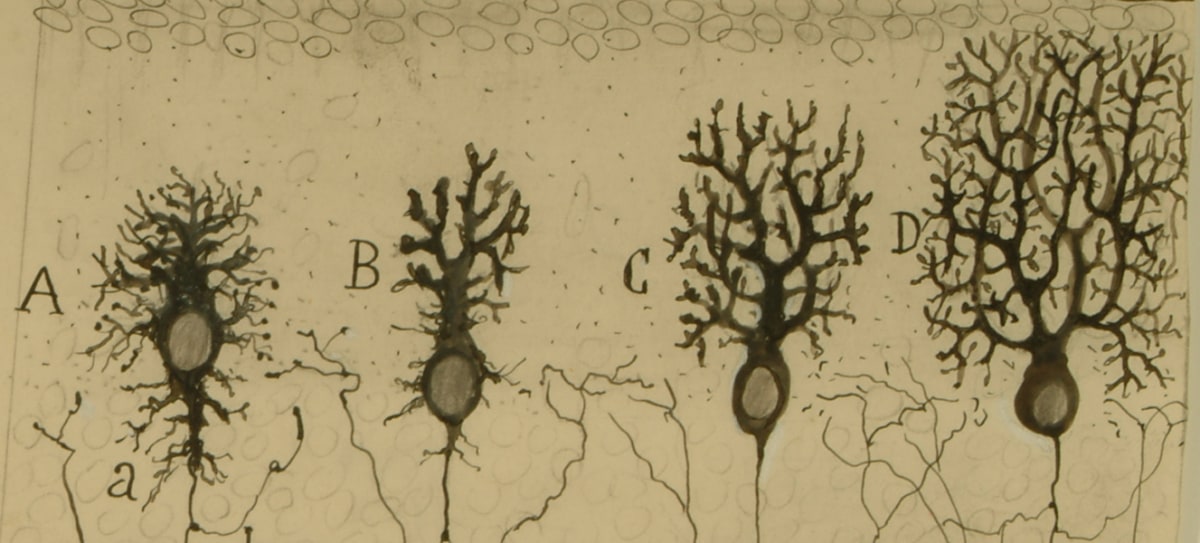
Scientific drawing by Santiago Ramón y Cajal, stages of the successive complication of the branching of the Purkinje cell, 1923. Courtesy of the Cajal Institute, Cajal Legacy, CSIC, Madrid.